Rapport & First Impressions
How you show up, the safety you create, and the listening that builds trust in the first three minutes.
Learning Objectives
By the end of this module, you will be able to:
- Prepare your professional identity before every client interaction using the Empowering Context Statement
- Diagnose and raise the TERA Quotient in real-time — creating the psychological safety your client’s brain needs to engage
- Deploy the Late-Night FM DJ Voice to project calm authority and build instant trust through vocal presence
- Run the Emotional Calibration Loop — label, silence, observe, recalibrate — to deepen rapport beyond surface pleasantries
- Recognise that your unconscious signals (body language, energy, demeanour) carry 80%+ of the impression you make
Core Concept 1: The Empowering Context — Who You Are BEING
The Model
THE EMPOWERING CONTEXT CHAIN
============================

+------------------+          +------------------+          +------------------+
|                  |          |                  |          |                  |
|     MINDSET      |  ------> |     ACTIONS      |  ------> |     RESULTS      |
|                  |          |                  |          |                  |
|  (Who you are    |          |  (What you do    |          |  (What you       |
|   BEING)         |          |   every day)     |          |   achieve)       |
|                  |          |                  |          |                  |
+------------------+          +------------------+          +------------------+
        ^
        |
+-------+--------+
|                 |
|   YOUR ECS      |
|                 |
| "I am a         |
|  [1], [2] and   |
|  [3] advisory   |
|  professional,  |
|  who [final     |
|  assertion]."   |
|                 |
+-----------------+
Most advisors prepare for client meetings by reviewing slides, rehearsing talking points, and checking the agenda. But the single biggest determinant of how a meeting goes is not what you say — it is who you are BEING when you say it.
Your mindset drives your actions. Your actions drive your results. This is a one-way chain. You cannot reverse-engineer great client relationships from a broken identity. When you show up as a determined, curious, client-focused advisor, the right behaviours emerge automatically. When you show up anxious about whether you will win the work, everything you do carries that energy — and the client reads it instantly.
The Tool: Empowering Context Statement (ECS)
“I am a [1], [2] and [3] advisory professional, who [final assertion].”
Three aspirational identity words plus a final assertion. Not who you hope to become — who you choose to BE, starting now.
Examples for advisory professionals:
- “I am a curious, fearless and relentless advisory professional, who always finds a way through.”
- “I am a trusted, incisive and generous advisory professional, who makes every client feel heard before offering a solution.”
- “I am a calm, prepared and decisive advisory professional, who brings clarity to complexity.”
The Internal Operating System: Think of your ECS as the operating system on a computer. No matter how powerful the applications (your technical skills, your frameworks, your domain expertise), they only perform as well as the underlying OS allows. A sluggish, corrupted OS produces slow, unreliable output regardless of how good the apps are. The ECS is the process of deliberately writing your own operating system — choosing the core code that everything else runs on.
Case Study: The Monday Morning Mirror
Sarah had been a technology advisor for six years. Competent. Good technical knowledge. But stuck — always landing between 85-95% of her advisory targets, never quite breaking through. Her practice lead, James, tried everything: sent her on training courses, gave her better accounts, paired her with a mentor. Nothing stuck.
One Tuesday, James did something different. He pushed a blank index card across the table: “Write down who you ARE as an advisor. Not what you do. Not your specialism. WHO. YOU. ARE.”
Sarah wrote: “I am a curious, fearless and relentless advisory professional, who always finds a way through.”
She put the card on her bathroom mirror. Over twelve weeks, her daily decisions shifted. She prepared more thoroughly because a curious person would. She followed up faster because a relentless person would. She asked harder questions because a fearless person would. Same skills. Different person deploying them.
End of quarter: 112% of target. First time above 100% in two years.
“I stopped trying to fix my numbers,” she said. “I fixed me.”
Practice Exercise
Before your next client meeting:
- Write your personal ECS on an index card using the formula
- Read it aloud before you leave for the meeting
- Ask yourself: “What would a [word 1], [word 2], [word 3] advisor do right now?”
- After the meeting, reflect: where did you act from your ECS? Where did you slip back to default?
Core Concept 2: The TERA Quotient — Creating Psychological Safety
The Model
      THE TERA QUOTIENT
==========================================
Your client's brain asks 5x per second: Safe or Dangerous?

UNSAFE  <----[dial]---->  SAFE
+-----------+-----------+-----------+-----------+
|     T     |     E     |     R     |     A     |
|           |           |           |           |
|   TRIBE   | EXPECTA-  |   RANK    | AUTONOMY  |
|           |   TION    |           |           |
|  "Is this |  "Do I    | "Am I     | "Do I get |
|   person  |   know    |  respected|  a say    |
|   with me |   what's  |  here?"   |  or       |
|   or      |   next?"  |           |  don't I?"|
|   against |           |           |           |
|   me?"    |           |           |           |
+-----------+-----------+-----------+-----------+
Most advisors believe their job in a first meeting is to demonstrate expertise — to prove they are worth the client’s time. But neuroscience says the client’s brain has a more basic question: Is it safe here?
Your client’s brain scans for safety five times every second across four dimensions. When the TERA Quotient is high, the brain operates at its most sophisticated level — nuanced thinking, positive assumptions, willingness to share real problems. When it is low, the amygdala fires and rational thinking shuts down.
| Dial | The brain asks | In a client meeting... |
|---|---|---|
| T — Tribe | “Are you with me or against me?” | Are you here to sell me something, or to genuinely understand my world? |
| E — Expectation | “Do I know what happens next?” | Have you set a clear agenda? Do I know what this meeting is for? |
| R — Rank | “Am I respected here?” | Are you listening to my thinking, or waiting to tell me yours? |
| A — Autonomy | “Do I get a say?” | Am I choosing the direction here, or being led somewhere? |
The Advisory Application: Questions raise TERA. Advice lowers it. When you walk into a client meeting and open with “Based on our analysis, here is what we recommend...” you are lowering Rank (their thinking is bypassed) and Autonomy (the direction has been chosen for them). When you open with “What is the most pressing challenge you are navigating right now?” you raise Tribe, preserve Rank, and increase Autonomy.
Case Study: The Eighteen-Second Hijack
A senior advisor — call him James — had a client meeting with a CEO named Sarah who had spent three weeks preparing a strategic roadmap. She walked in carrying a deck she was quietly proud of.
James leaned back: “So what have you got?”
Sarah opened slide one. She had barely finished her second sentence when James sat forward: “OK, I see where you’re going with this. Here is the thing — we tried something like this two years ago and the board pushed back. What you really need to do is...”
For the next eight minutes, James laid out his version. He ended with: “Does that make sense?”
Sarah nodded. “Yes, that makes sense.” She walked back to her desk and closed her laptop. She did not open the remaining twenty-three slides.
In the eighteen seconds before James interrupted, her TERA collapsed:
- Tribe: He was correcting her, not with her
- Expectation: The conversation became a lecture without warning
- Rank: Three weeks of work overridden in a sentence
- Autonomy: The direction had been decided for her
Three months later, the project underperformed. Sarah had known about the market signals. She just had not felt safe enough to say so.
James’s job was not to provide the answer. His job was to create the conditions where the best answers could emerge.
Practice Exercise: The TERA Audit
Do this after your next client meeting:
- Score each TERA dial 1-5 for the meeting (from the client’s perspective, not yours)
- Which dial was lowest? What specifically lowered it?
- What one thing could you do differently next time to raise that dial by two points?
- Ask yourself honestly: how much of the meeting was you asking questions versus you giving advice?
Core Concept 3: Vocal Presence & The Emotional Calibration Loop
The DJ Voice Technique
THE DJ VOICE TECHNIQUE

PITCH:     HIGH -------> LOW      (go deep)
SPEED:     FAST -------> SLOW     (stretch it out)
INFLECTION: UP? -------> DOWN.    (declare, don't ask)
VOLUME:    LOUD -------> SOFT     (draw them in)

RESULT:    FIGHT ------> TRUST
           CHAOS ------> CALM
           REACT ------> REFLECT
Chris Voss, the FBI’s former lead hostage negotiator, calls it the Late-Night FM DJ Voice. Deep. Soft. Slow. Reassuring. When you lower your pitch and slow your cadence, the other person’s nervous system responds — they calm down, lean in, and begin to trust you. Not because of what you said, but because of how you sounded saying it.
Think of a radio host at midnight. Unhurried pacing. Deep bass notes. A presence that fills the silence without crowding it. The listener does not have to fight to hear you. They lean in because the frequency draws them.
The Emotional Calibration Loop
THE EMOTIONAL CALIBRATION LOOP

    +---------------------------------------------+
    |                                             |
    v                                             |
 +----------+    +----------+    +---------+      |
 | 1. DETECT |--->| 2. LABEL  |--->|3. SILENCE|     |
 | Observe   |    | "It seems |    | Wait.    |     |
 | words,    |    |  like..."  |    | 4+ sec.  |     |
 | tone,     |    | "It sounds |    | Let it   |     |
 | body      |    |  like..."  |    | land.    |     |
 +----------+    +----------+    +----+----+      |
                                      |           |
                                      v           |
                                +----------+      |
                                |4. OBSERVE |      |
                                | Read the  |      |
                                | response  |------+
                                +----------+
Real rapport is not built by talking. It is built by naming what the other person feels, then going silent. “It seems like this project has been weighing on you.” Then silence. Not awkward silence — working silence. That is where trust is built.
Each time you label an emotion and wait, you peel back one more layer. The conversation deepens. The relationship strengthens.
The Rule: When describing emotion, use third-person phrasing: “It seems like...” “It sounds like...” “It looks like...” Never “I think you feel...” The word “I” makes you the subject. The word “It” keeps the focus on their experience.
Case Study: Discovery Over Assumption
A technology advisor walked into a first meeting with a new CEO. She had done her preparation: reviewed the company’s annual report, read the board papers, identified three likely pain points. She was tempted to open with her analysis — to demonstrate she had done her homework.
Instead, she lowered her voice, slowed her cadence, and asked: “What is the one thing keeping you up at night right now?”
The CEO paused. “Honestly? It is not the technology. It is the board. They approved a transformation programme eighteen months ago, and now they are questioning whether it was the right call. My team can feel the doubt. It is paralysing.”
None of the advisor’s three hypotheses had included board confidence. She had assumed an operational problem. The real problem was political.
She labelled: “It sounds like you are carrying the weight of a decision that was not entirely yours, and the people who made it are starting to waver.”
Silence. Four seconds. Five.
“That is exactly it,” the CEO said. “Nobody has said that out loud before.”
Enter every meeting with hypotheses, not scripts. Your preparation is not wasted — it gives you a starting point. But treat it as a starting point to test, not a conclusion to confirm.
Practice Exercise: Label and Listen
Try this in your next client conversation:
- Identify one moment where the client expresses frustration, concern, or uncertainty
- Lower your voice (think midnight radio)
- Label what you observe: “It seems like...” or “It sounds like...”
- Stop talking. Count to four silently. Resist every urge to fill the void
- Listen to what comes back — correction, elaboration, or deeper reveal
- After the conversation, note: what did you learn that you would not have learned by asking a direct question?
Synthesis: How the Three Concepts Connect
BEFORE THE MEETING          DURING THE MEETING          THROUGHOUT
----------------           ------------------          ----------

EMPOWERING CONTEXT    ->    TERA QUOTIENT         ->    CALIBRATION LOOP
(Who you are BEING)        (Safety you create)         (How you deepen)

"Be it. Do it. Get it."   "Safe brains think         "Label it, let it land."
                            better."
Your Empowering Context sets the internal operating system. It determines who walks through the door.
The TERA Quotient is what your client’s brain reads the moment you arrive. Your ECS-driven presence raises all four TERA dials simultaneously: you signal Tribe (genuine curiosity), set Expectation (calm confidence), preserve Rank (their thinking matters), and increase Autonomy (questions, not prescriptions).
The Calibration Loop is the ongoing process that deepens rapport from surface pleasantry to genuine trust. Each label-and-listen cycle peels back a layer. The client moves from guarded politeness to authentic disclosure.
Marcus Child’s Communication Quadrant: 80%+ of what your client reads is not your words but your unconscious signals — body language, energy, demeanour, vocal tone. Your client’s brain is tuned to AM — the low-frequency broadcast of how you show up — not FM — the carefully crafted content of your presentation.
The FIRO-B Engagement Sequence: Engagement builds in a strict order: Inclusion → Control → Warmth. First make the client feel included. Then trust them with control. Only then does warmth land authentically. Warmth without inclusion is a castle on sand.
Crib Sheet
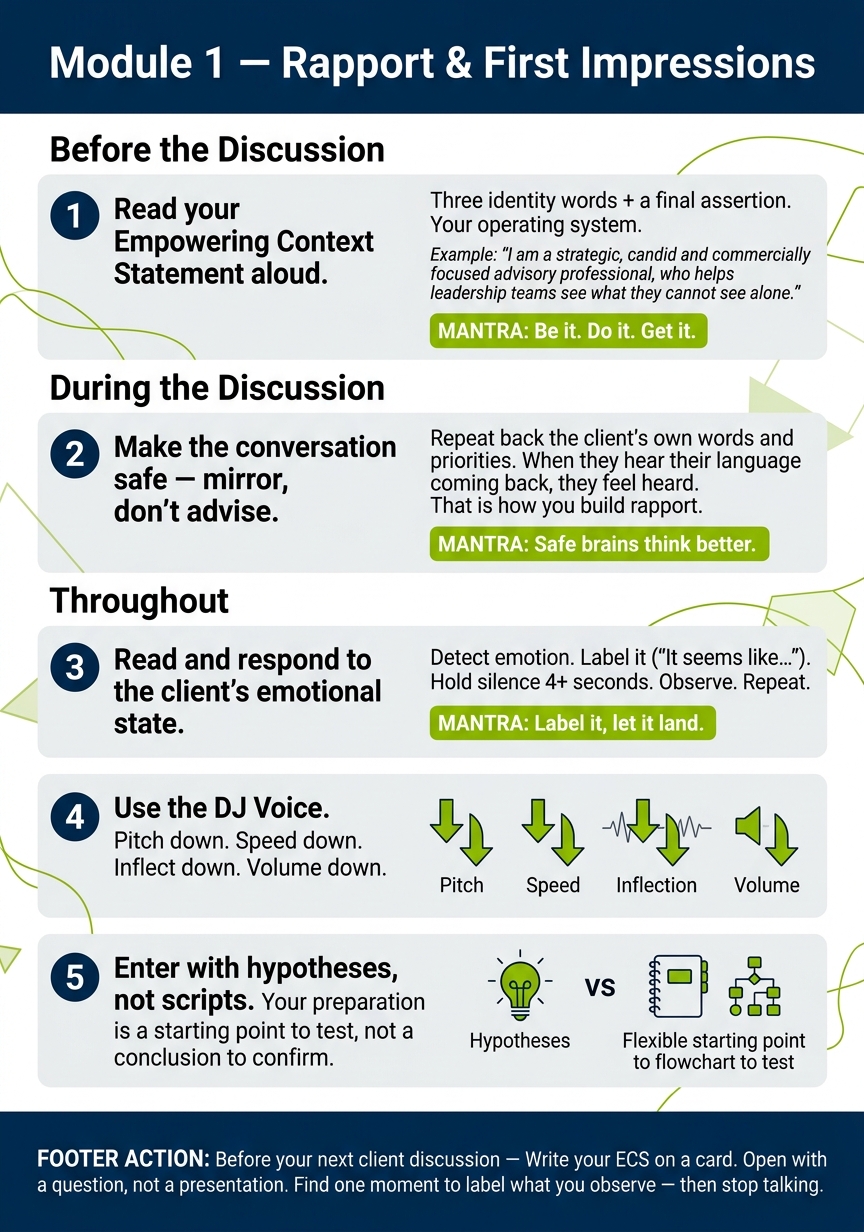
Before the Discussion
1. Read your Empowering Context Statement aloud. Three identity words + a final assertion. This is your operating system. Example: “I am a strategic, candid and commercially focused advisory professional, who helps leadership teams see what they cannot see alone.”
Be it. Do it. Get it.
During the Discussion
2. Make the conversation safe — mirror, don’t advise. Your instinct is to demonstrate value by offering advice early. Resist it. Repeat back the client’s own words and priorities. When they hear their language coming back, they feel heard. That is how you build rapport.
Safe brains think better.
Throughout
3. Read and respond to the client’s emotional state. Detect emotion. Label it (“It seems like…”). Hold silence for 4+ seconds. Observe. Repeat.
Label it, let it land.
4. Use the DJ Voice. Pitch down. Speed down. Inflect down. Volume down.
5. Enter with hypotheses, not scripts. Your preparation is a starting point to test, not a conclusion to confirm.
Active Listening
The skill that separates advisors who hear from advisors who understand. Mirroring, labelling, and calibrated silence.
Learning Objectives
By the end of this module, you will be able to:
- Diagnose which of the three listening traps — Pseudo, Selective, or Critical — is your unconscious default in client conversations
- Deploy the APEGOP discipline to shift from passive hearing to deliberate, active listening before every client interaction
- Use labeling and mirroring as a combined disclosure engine — surfacing the information your client has not yet volunteered
- Execute tactical silence after every label or mirror, holding the gap for at least four seconds to let the technique land
- Recall a client’s exact words after a meeting — not the gist, not your summary, but their language and the emotion behind it
Core Concept 1: The Three Listening Traps & the APEGOP Discipline
The Model
THE THREE LISTENING TRAPS vs ACTIVE LISTENING
===============================================

  PASSIVE (Unconscious Default)              ACTIVE (Conscious Discipline)
  ==============================             ==============================

  +-------------+  +-------------+  +-------------+       +------------------+
  |   PSEUDO    |  |  SELECTIVE  |  |  CRITICAL   |       |     ACTIVE       |
  |  LISTENING  |  |  LISTENING  |  |  LISTENING  |  ==>  |    LISTENING     |
  |             |  |             |  |             |       |                  |
  |  "Faking    |  | "Cherry-    |  | "Judging    |       |  A - Awareness   |
  |   it"       |  |  picking"   |  |  it"        |       |  P - Prepare     |
  |             |  |             |  |             |       |  E - Enthuse     |
  |  Pretend    |  | Hear only   |  | Build a     |       |  G - Goal        |
  |  to hear    |  | what suits  |  | counter-    |       |  O - Observe     |
  |             |  | you         |  | argument    |       |  P - Practice    |
  +-------------+  +-------------+  +-------------+       +------------------+

        THE TRAPS                                           THE DISCIPLINE
   (Default behaviour)                                   (Learned behaviour)

   "We talk and judge"             =====>           "We listen and absorb"
Most fractional CTOs believe they are good listeners. They let the client finish speaking, they take notes, they nod in the right places. But there is a difference between hearing words and absorbing meaning. After decades of professional conversations, most advisors have perfected three forms of bad listening without realising it — and the client senses every one.
Listening is not a personality trait. It is a discipline. The shift from passive to active listening is not about trying harder — it is about building conscious awareness through a repeatable practice.
The Tool: APEGOP Discipline
| Letter | Discipline | In Practice |
|---|---|---|
| A | Awareness | Notice when your mind drifts — press thumb and forefinger together as a physical reset |
| P | Prepare | Arrive with a blank notepad. Write LISTEN at the top. Leave your slides in the bag until asked |
| E | Enthuse | Cultivate genuine curiosity about the person, not just the engagement |
| G | Goal | Set a listening intention before each meeting: “What am I listening FOR?” |
| O | Observe | Read non-verbal cues — posture shifts, tone changes, pauses, eye movement |
| P | Practice | Treat listening as a trainable skill. Paraphrase, reflect, summarise, ask |
The Radio Dial: Think of listening as tuning a radio. Pseudo listening is having the radio on in the background — noise fills the room but you could not repeat a single sentence. Selective listening is scanning stations, pausing only on familiar songs. Critical listening is searching for static. Active listening is finding the right frequency, locking the dial, and leaning forward. The APEGOP discipline is your tuning system: six adjustments that keep you locked on the right frequency.
Case Study: The Discovery That Never Happened
Rachel had been a fractional CTO for four years. Strong technical credentials. Excellent preparation. But her conversion rate on discovery meetings was stuck at 30%. Her practice lead, David, sat in on a meeting to observe.
The client was Martin, CEO of a mid-market logistics company. Martin opened by describing his frustration with a failed ERP implementation. Rachel nodded, took notes, and — the moment Martin paused — launched into a detailed explanation of how she would approach the problem differently.
David watched Martin’s face. The moment Rachel started talking, Martin leaned back. His arms crossed. He smiled politely and said nothing for the remaining twenty minutes.
Afterwards, David asked: “He mentioned his board three times. He said the words ‘my reputation’ once. He paused for four seconds after mentioning the vendor selection process. What was he really worried about?”
Rachel could not answer. She had been selectively listening — hearing the technology problem because that was her domain — and missing the political fear underneath. Rachel never got a second meeting with Martin.
“I heard every word about the technology. I missed every word about the person.”
Practice Exercise
Before your next client meeting:
- Write your listening goal at the top of a blank notepad — one sentence describing what you are listening FOR beyond the obvious agenda
- During the meeting, press thumb and forefinger together each time you catch your mind preparing a response instead of hearing what is being said
- After the meeting, write down three specific things the client said — their exact words, not your paraphrase
- Score yourself honestly: which of the three traps did you fall into, and at what moment?
Core Concept 2: Labeling & Mirroring — The Disclosure Engine
The Model
THE DISCLOSURE ENGINE: MIRROR → LABEL → SILENCE
=================================================

CLIENT:  "This timeline is impossible."
                    |
          MIRROR ---|
                    v
YOU:     "Impossible?"
                    |
CLIENT:  "We tried this before and it fell apart at implementation."
                    |
          LABEL  ---|
                    v
YOU:     "It sounds like past experience has made you
          skeptical this can work."
                    |
       SILENCE  ---|  (count to 4)
                    v
CLIENT:  "Honestly, yes. Last year we lost credibility with the
          board on a similar initiative. Nobody wants to sponsor
          this one."

    Each cycle peels back one layer.
    Keep going until you reach the real issue.
Most advisors gather information by asking questions. Good questions. Smart questions. But questions have a hidden cost: they put the client in response mode. The client answers what you asked — not what they needed to say. Labeling and mirroring bypass this limitation. They invite disclosure without directing it.
A mirror (repeating the client’s last 1-3 words with an upward inflection) creates an echo that compels elaboration. A label (naming the emotion behind what the client said, using “It seems like...” or “It sounds like...”) validates their experience and invites them to go deeper. Together, they form a disclosure engine: mirror → label → silence → mirror → label → silence.
The Critical Rule: Never follow a label with a question. Never end a label with “...right?” or “...don’t you think?” The label is the invitation. Adding a question channels their response into a narrow answer instead of an open disclosure.
The Disclosure Onion: Think of every client conversation as an onion. The outer layer is what they tell everyone — the sanitised version. Direct questions peel one layer at a time. But the mirror-label-silence sequence peels layers without the client even realising the onion is being dismantled. By the third cycle, you are four layers in. Your competitor, asking smart questions, is still on layer two.
Case Study: The Budget That Was Not About Money
Tom was a fractional CTO advising a retail chain. Three months in, the CFO, Lisa, called an unscheduled meeting. She opened with: “I need to talk about the budget for the digital programme.”
Tom mirrored: “The budget?”
Lisa paused. “The board is asking questions about the overall technology spend. Not just yours. Everything.”
Tom labelled: “It sounds like the scrutiny is not specific to this programme — it is a wider confidence issue.”
Silence. Four seconds. Five.
Lisa leaned forward. “Between us, the CEO is under pressure from two new board members. He is not going to fight for any single programme. If your engagement gets caught in that sweep, I cannot protect it.”
In ninety seconds, Tom had moved from “budget discussion” to the real issue: board-level politics, a CEO who would not defend the spend, and a CFO who was warning him as an ally, not challenging him as an adversary.
“She did not call me to discuss the budget. She called me to tell me the ground was shifting. I almost missed it.”
Practice Exercise: The Mirror-Label Drill
Practise this week:
- In your next client conversation, identify one statement that carries emotional weight
- Mirror the last 1-3 words with a curious upward inflection. Then stop.
- When they elaborate, label the underlying emotion: “It seems like...” or “It sounds like...” Do NOT start with “I”
- Hold silence for four seconds after the label. Count in your head. Resist every urge to fill the gap
Core Concept 3: Tactical Silence — The Gap Is the Gift
The Model
THE TACTICAL SILENCE CYCLE
============================

   STEP 1             STEP 2              STEP 3
   INTERVENE          SILENCE             LISTEN
   ---------          ---------           ---------
   Deliver:           STOP.               Observe:
   - Label             4+ seconds          - What they say
   - Mirror            minimum             - How they say it
   - Calibrated                            - What shifts
     question          Do NOT:             - New information
                       - Explain             revealed
                       - Add context
                       - Ask a follow-up
                       - Restate           RECALIBRATE
                       - Apologise              |
                                                v
        +----------------------------------------------+
        |            REPEAT THE CYCLE                  |
        |   New intervention based on what the         |
        |   silence revealed                           |
        +----------------------------------------------+
Most fractional CTOs fear silence. They interpret a pause as failure — the label did not land, the question confused the client. So they fill the gap. They explain. They restate. They soften. And in doing so, they destroy the very technique they just deployed.
Silence is not the absence of communication. It is the most powerful move you can make after any empathic intervention. When you deliver a label and stop talking, the client’s brain fills the vacuum. They elaborate, they correct, they confess, they reveal.
The Rule: After every label, mirror, or calibrated question, close your mouth. Breathe through your nose. Maintain calm eye contact. Count: one-Mississippi, two-Mississippi, three-Mississippi, four-Mississippi. Minimum.
White Space on a Page: Think of silence as white space in design. When every inch of a page is filled with text, nothing stands out. But when white space surrounds a single phrase, that phrase becomes the most powerful element on the page. Tactical silence surrounds your label or mirror with empty space, making it the most prominent thing in the conversation.
Case Study: The Silence That Saved the Engagement
Nadia was a fractional CTO six months into an advisory engagement with a manufacturing firm. The CEO, Alan, had been progressively disengaging — shorter emails, fewer questions, delegating meetings to his COO.
In their quarterly review, Nadia resisted the instinct to ask “Any questions?” Instead, she lowered her voice and labelled: “It seems like the programme might not be addressing what matters most to you right now.”
Then she stopped. Completely. Three seconds. Five. Eight.
Alan exhaled. “Honestly, Nadia, I backed this programme because I believed in the vision. But the last two board meetings have been brutal. The non-executives are pushing for short-term cost savings and I am burning political capital defending a long-term technology investment.”
If Nadia had asked “Do you have any concerns?” Alan would have said “No, it is fine.” The label followed by silence gave him permission to say what he had not said to anyone.
Nadia restructured the next phase to deliver two visible quick wins within sixty days. The engagement not only survived but expanded.
“I asked zero questions that day. The silence did all the asking.”
Practice Exercise: The Four-Second Challenge
Try this in your next meeting:
- Identify one moment where you deliver a label or a mirror
- After delivering it, close your mouth. Physically. Press your lips together if you have to
- Count: one-Mississippi, two-Mississippi, three-Mississippi, four-Mississippi. Do NOT speak
- Observe what happens: do they elaborate? Correct you? Go deeper? That response contains information that your next sentence would have destroyed
Synthesis: How the Three Concepts Connect
BEFORE THE MEETING          DURING THE MEETING          THE AMPLIFIER
----------------           ------------------          -------------

THREE LISTENING TRAPS  ->   LABELING & MIRRORING   ->   TACTICAL SILENCE
(Know your default)        (The active tools)          (The force multiplier)

"Which trap am I in?"      "Mirror the words,          "The gap is the gift."
                            label the feeling."

       AWARENESS                TECHNIQUE                 DISCIPLINE
The Three Listening Traps diagnose the problem. Before you can listen actively, you need to know how you listen badly. Every fractional CTO has a default trap — Pseudo, Selective, or Critical. The APEGOP discipline provides the conscious reset.
Labeling & Mirroring are the active tools of listening. They replace the advisor’s instinct to ask questions with a disclosure engine that invites the client to reveal more than any question would extract.
Tactical Silence is the force multiplier. Without it, labels are just statements and mirrors are just repetition. The four-second pause after every intervention is what transforms a technique into an invitation.
The Progression: You diagnose your trap (awareness), deploy the technique (mirror or label), and then amplify it (silence). Each cycle peels back one more layer. By the third cycle, you are hearing what the client has not told anyone else. That is the competitive advantage.
Crib Sheet
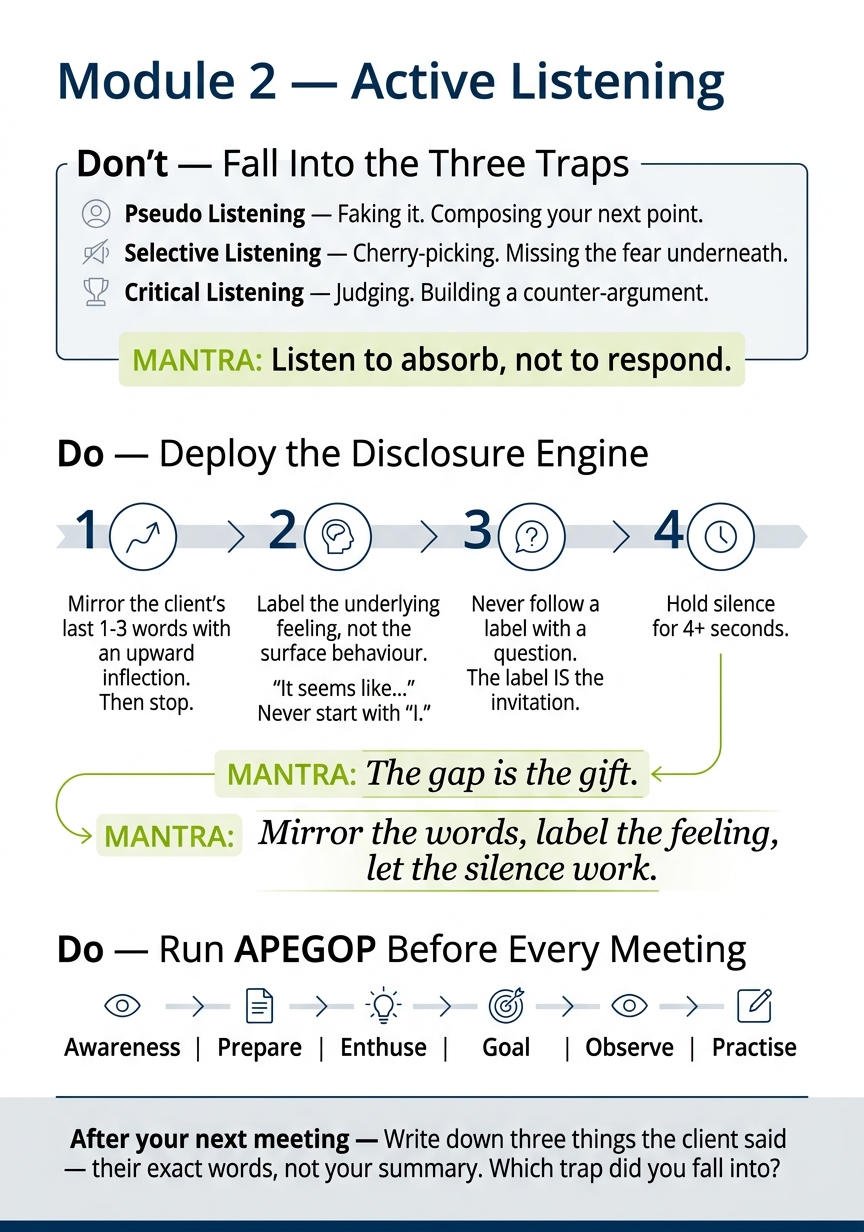
Don’t: Fall Into the Three Traps
- Pseudo Listening — Faking it. You look attentive but you are composing your next point.
- Selective Listening — Cherry-picking. You hear the technology problem and miss the political fear underneath.
- Critical Listening — Judging it. You build a counter-argument instead of building understanding.
Listen to absorb, not to respond.
Do: Deploy the Disclosure Engine
- Mirror the client’s last 1–3 words with an upward inflection. Then stop.
- Label the underlying feeling, not the surface behaviour. “It seems like…” Never start with “I.”
- Never follow a label with a question. The label IS the invitation.
- Hold silence for 4+ seconds.
The gap is the gift.
Mirror the words, label the feeling, let the silence work.
Do: Run APEGOP Before Every Meeting
Awareness | Prepare | Enthuse | Goal | Observe | Practise
Asking Powerful Questions
The highest-leverage advisory skill. Calibrated questions, the GROW coaching architecture, and value quantification.
Learning Objectives
By the end of this module, you will be able to:
- Construct calibrated questions using only “What” and “How” — giving your client the illusion of control while you direct the conversation
- Deploy the GROW sequence — Goal, Reality, Options, Will — to turn any advisory conversation into a coaching conversation that builds client ownership
- Apply the Four Value Questions to transform a vague client complaint into a quantified business case the client calculates themselves
- Recognise when you are jumping to solutions and use structured questioning to stay curious longer
- Surface hidden stakeholders and political dynamics through behind-the-table questions that reveal what the client has not volunteered
Core Concept 1: Calibrated Questions — The Illusion of Control
Framework: Calibrated Questions System (Chris Voss, Never Split the Difference) | Card Ranking: ACE
Model
THE CALIBRATED QUESTIONS MATRIX
================================

                    PURPOSE / FUNCTION
              Info         Problem       Implement    Behind-
              Gathering    Solving       Securing     the-Table
         +------------+------------+------------+------------+
         |            |            |            |            |
  WHAT   | What is    | What is    | What       | What do    |
  ques-  | the big-   | the core   | happens if | your board |
  tions  | gest chal- | issue      | we do      | see as the |
         | lenge you  | here?      | nothing?   | main       |
         | face?      |            |            | concern?   |
         +------------+------------+------------+------------+
         |            |            |            |            |
  HOW    | How does   | How am I   | How will   | How does   |
  ques-  | this fit   | supposed   | we know    | this affect|
  tions  | into your  | to do      | we are on  | the rest   |
         | priorities?| that?      | track?     | of your    |
         |            | [G.O.A.T.] |            | team?      |
         +------------+------------+------------+------------+

  AVOID: “Why” = accusation in any language
  AVOID: “Can/Is/Are/Do/Does” = closed-ended, yes/no answers

  THE MECHANISM:
  +-----------+     +-----------+     +-----------+
  | Ask for   | --> | Suspend   | --> | They solve|
  | HELP      |     | UNBELIEF  |     | YOUR      |
  | (How/What)|     | (illusion |     | problem   |
  |           |     | of control)|    | as THEIRS |
  +-----------+     +-----------+     +-----------+
Explanation
The Contrast: Most fractional CTOs walk into client meetings armed with expertise. They hear a problem, and their instinct is to solve it — immediately, impressively, comprehensively. But the moment you start providing answers, you take ownership of the problem away from the client.
The Principle: The person who asks the questions controls the conversation. When you ask a carefully constructed open-ended question beginning with “What” or “How,” you give the client the illusion of control while you frame the entire exchange. Their brain shifts from evaluating your proposal to solving the problem alongside you.
The Tool: Calibrated questions use only two words to start: “What” and “How.” Never “Why” — which is always an accusation, in any language. The G.O.A.T. question — “How am I supposed to do that?” — is the single most powerful way to say “No” without ever using the word.
Examples for advisory professionals:
- CEO demands a full transformation roadmap in two weeks: “How am I supposed to deliver that level of rigour in that timeframe?”
- Board questions the technology investment: “What would need to be true for the board to see this as a strategic asset rather than a cost?”
- CFO pushes back on programme budget: “How does this compare to the cost of not solving the problem?”
Ask for help. Get control.
Case Study: The Roadmap That Built Itself
Marcus had been advising a logistics firm for three months when the CEO, Helen, called an emergency meeting. The board had approved a digital transformation budget, but Helen wanted a full implementation roadmap within ten days.
Instead of cancelling his other commitments and building it himself, he asked one question: “What would a roadmap need to include for the board to feel confident releasing the budget?”
Helen started listing priorities. Marcus mirrored: “Customer portal?” Helen elaborated for five minutes, revealing it was her personal initiative — she was worried about losing it in a broader programme. Marcus labelled: “It sounds like there is a concern that the portal might get deprioritised.”
In forty minutes, Helen had articulated the roadmap structure herself. The board approved it in full — three days early.
“I stopped building roadmaps for clients. I started asking the questions that helped them build their own.”
Practice Exercise
- Write down the three most likely demands or objections your client will raise
- For each, construct a calibrated “What” or “How” question that redirects energy back to the client
- Practise delivering the G.O.A.T. question in a warm, genuinely curious tone
- After the meeting, review: how many questions began with “What” or “How”? How many slipped?
Core Concept 2: The GROW Model — Destination Before Direction
Framework: The GROW Model (Sir John Whitmore, Coaching for Performance) | Card Ranking: ACE
Model
THE GROW MODEL
==============

    +--------+     +----------+     +---------+     +--------+
    |   G    | --> |    R     | --> |    O    | --> |   W    |
    |  GOAL  |     | REALITY  |     | OPTIONS |     |  WILL  |
    |        |     |          |     |         |     |        |
    | What   |     | What is  |     | What    |     | What   |
    | do you |     | happening|     | could   |     | WILL   |
    | want?  |     | now?     |     | you do? |     | you do?|
    +--------+     +----------+     +---------+     +--------+
         ^              |                |               |
         |              |                |               |
         +--------------+----------------+---------------+
                    RECURSIVE LOOPS

    ================================================
    FOUNDATION: Awareness + Responsibility
    ================================================

    COMMITMENT TEST:
    “On a scale of 1 to 10, how committed are you?”
    Below 8 = unlikely to happen. Adjust the action.
Explanation
The Contrast: Most advisors jump straight to solutions. A CEO describes a challenge, and the fractional CTO immediately begins architecting the answer. This skips three critical stages: understanding what the client actually wants, honestly examining where they are, and exploring the full range of what is possible.
The Principle: The sequence matters more than the content. Goal before Reality. Reality before Options. Options before Will. Skip a stage and the whole architecture collapses.
The Tool: GROW is a four-stage coaching conversation architecture. Each stage uses questions, not statements. The recursive loops mean you can return to earlier stages as new information emerges. The commitment test — “On a scale of 1 to 10?” — is the litmus test. Below an 8, the action will not happen.
Destination before direction.
Case Study: The CTO Who Stopped Solving
David was the kind of fractional CTO every CEO loved to hire and quietly resented three months later. Brilliant. Fast. Always had an answer. Six months into an engagement with a SaaS company, the CEO, Priya, had stopped attending their weekly catch-ups.
He changed his approach entirely. Instead of presenting infrastructure recommendations, he opened with: “What does a successful technology function look like for this business in twelve months?”
Priya talked for fifteen minutes — revealing a board member pushing for an acquisition rather than building internally. David had been solving the wrong problem for months.
He moved through Reality, Options, and Will. Priya committed to three actions. David asked: “On a scale of 1 to 10?” She said 9. She completed all three. The engagement extended by a year.
“The day I stopped being the smartest person in the room was the day I became indispensable.”
Practice Exercise
- Write G-R-O-W at the top of your notepad before the meeting begins
- Open with a Goal question: “What would make this conversation valuable for you today?”
- When you feel the pull to offer a solution, check: have you completed Reality and Options first?
- Close with the commitment test: “On a scale of 1 to 10, how committed are you?”
Core Concept 3: The Four Value Questions — Quantify or Qualify
Framework: The Four Value Questions (Kiss the Fish / The Art of Selling) | Card Ranking: KING
Model
THE FOUR VALUE QUESTIONS
========================

  VAGUE PROBLEM                              QUANTIFIED VALUE
       |                                            |
       v                                            v

  +-----------+  +-----------+  +-----------+  +-----------+
  |    Q1     |  |    Q2     |  |    Q3     |  |    Q4     |
  | “How do  |  | “What is |  | “What    |  | “What is |
  |  you      |  |  it now?” |  |  should   |  |  the value|
  |  measure  |  |           |  |  it be?”  |  |  of the   |
  |  that?”   |  |           |  |           |  | difference|
  |           |  |           |  |           |  |    ?”     |
  +-----------+  +-----------+  +-----------+  +-----------+
    IDENTIFY       ANCHOR        ASPIRE         CALCULATE

  FALLBACK: If no hard metric exists, use a 1-10 SCALE
  “On a scale of 1 to 10, where are you now?
   Where should you be?”
Explanation
The Contrast: Most fractional CTOs have conversations about technology — architectures, platforms, migration strategies. The CEO listens, evaluates, and inevitably asks about cost. The conversation becomes a price negotiation because value was never established.
The Principle: The customer who calculates the value themselves will never challenge your fees in the same way again. When they tell you the problem is costing them 1.2 million pounds a year, they own that number. They cannot un-hear it.
The Tool: Four questions in sequence. Q1 — “How do you measure that?” Q2 — “What is it now?” Q3 — “What should it be?” Q4 — “What is the value of the difference?” When hard metrics do not exist, switch to the 1-10 qualifying fallback.
Quantify or qualify — never leave value vague.
Case Study: The Number That Changed the Conversation
Emma was three weeks into a discovery engagement with a mid-market retailer. The CEO, Tom, kept saying: “Our technology estate is holding us back.”
She asked: “When you say holding you back — how do you measure that?” Tom said time to launch new products: fourteen weeks from concept to shelf. “What should it be?” Competitors did it in six; he targeted eight. “What is the value of the difference?”
Tom pulled out a spreadsheet. After two minutes: “That is north of two million pounds in incremental revenue.”
Emma’s subsequent proposal was three times her standard engagement size — and Tom signed without negotiating the fee.
“I did not tell him the value. He told me. And once he said the number out loud, he could not un-hear it.”
Practice Exercise
- Identify one vague complaint your client has expressed
- Write out the four questions adapted to that specific complaint
- If no hard metric is likely, prepare the 1-10 fallback version
- After the meeting, record the value figure — this anchors every subsequent conversation about scope and fees
Synthesis: How the Three Systems Connect
Calibrated Questions provide the language rules — the precise construction that keeps every question open-ended, non-threatening, and control-giving.
The GROW Model provides the conversation architecture — the disciplined sequence that ensures you understand what the client wants before you explore how to get there.
The Four Value Questions provide the commercial engine — the mechanism that transforms vague concerns into quantified business cases.
The Progression: You calibrate your language (What/How only), follow the GROW sequence (Goal → Reality → Options → Will), and when you hear a vague problem during Reality, deploy the Four Value Questions to quantify the gap. The client owns the number. The engagement is anchored to value, not cost. That is the competitive advantage.
Crib Sheet
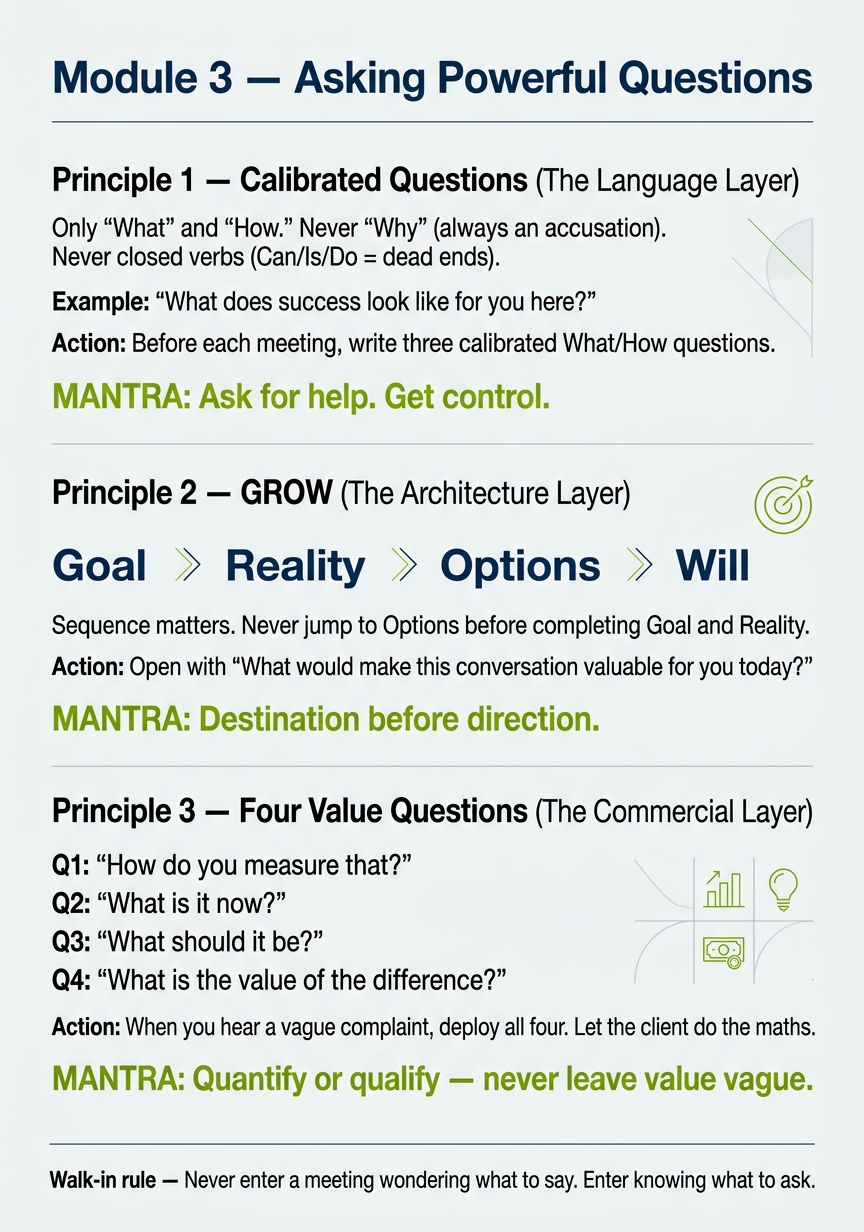
Principle 1: Calibrated Questions — The Language Layer
Only “What” and “How.” Never “Why” (always an accusation). Never closed verbs (Can/Is/Do = yes/no dead ends). Example: “What does success look like for you here?”
Action: Before each meeting, write three calibrated What/How questions for the most likely objections.
Ask for help. Get control.
Principle 2: GROW — The Architecture Layer
Goal → Reality → Options → Will. Sequence matters. Never jump to Options before completing Goal and Reality.
Action: Open with a Goal question: “What would make this conversation valuable for you today?” Destination before direction.
Principle 3: Four Value Questions — The Commercial Layer
Q1: “How do you measure that?” → Q2: “What is it now?” → Q3: “What should it be?” → Q4: “What is the value of the difference?”
Action: When you hear a vague complaint, deploy all four questions and let the client do the maths.
Quantify or qualify — never leave value vague.
Customer Discovery
Turn conversations into commercial opportunities. Problem, result, transformation — the structure that uncovers what clients actually need.
Learning Objectives
By the end of this module, you will be able to:
- Diagnose a client’s Problem, Result, and Transformation in their own language before proposing any solution
- Structure discovery conversations using the Five KNOWs progression so that trust deepens with every exchange
- Distinguish between surface-level needs and the deeper transformation your client is actually pursuing
- Apply the Art of Qualification’s dual-perspective lens to determine whether an opportunity deserves your time
- Run the continuous qualification loop — “Am I winning or losing right now?” — at every stage of an advisory engagement
Core Concept 1: Problem-Result-Transformation (PRT) — The Three Buying Conversations
The Model
THE PRT FLOW
============

    +-------------+        +-------------+        +-----------------+
    |             |        |             |        |                 |
    |   PROBLEM   | -----> |   RESULT    | -----> | TRANSFORMATION  |
    |             |        |             |        |                 |
    |  “Have and  |        |  “Want and  |        |  “What they     |
    |  don’t want”|        |  don’t have”|        |   become”       |
    +-------------+        +-------------+        +-----------------+
          ^                                              |
          |                                              |
          +----------------------------------------------+
                    (Circular return: new level,
                     new problems, new journey)
Most fractional CTOs walk into a first meeting armed with a capabilities deck, a methodology slide, and a list of past engagements. They spend forty-five minutes demonstrating what they can do — and leave without ever discovering what the CEO actually needs done. The conversation is about the advisor’s product, not the client’s problem.
People do not buy advisory services. They buy because there is a problem they have and do not want, and/or a result they want and do not have, so that they are transformed. Every advisory conversation should orbit these three elements — not the advisor’s credentials.
The Tool: PRT Diagnostic
The PRT diagnostic asks three questions before every engagement:
- What is the Problem the client has and does not want? (In their words, not yours.)
- What is the Result they want and do not have? (Concrete, measurable.)
- What is the Transformation they are seeking? (What will they look like after?)
Examples for advisory professionals:
- A CEO tells you their systems are fragmented. The Problem is fragmentation; the Result is a unified platform; the Transformation is a business that can scale internationally without the technology holding them back.
- A CFO says technology costs are “out of control.” The Problem is spiralling spend; the Result is a 20% cost reduction within twelve months; the Transformation is a board that trusts technology as an investment rather than a liability.
- A CEO describes their team as “always firefighting.” The Problem is reactive operations; the Result is a proactive, roadmap-driven function; the Transformation is a technology team that the rest of the business respects and relies upon.
The Doctor’s Consultation: Think of PRT as a doctor’s consultation. No good doctor walks into the room and immediately starts prescribing medication. They ask questions to understand the symptoms (the Problem). They run diagnostics to determine the desired healthy state (the Result). And they paint a picture of recovery — what life will look like when the patient is well again (the Transformation). A fractional CTO who skips straight to recommending solutions without diagnosing the Problem, Result, and Transformation is doing exactly what a negligent doctor does — prescribing before diagnosing.
Case Study: The Wrong Slide Deck
David had been a fractional CTO for three years. Technically excellent. Strong track record. But he kept losing competitive pitches to advisors he considered less experienced. His practice lead, Rachel, joined him on a ride-along to observe.
The meeting was with Helen, CEO of a mid-sized logistics company. David opened with a polished twenty-minute presentation: his methodology, his sector experience, three relevant case studies. Helen listened politely. At the end she said: “That is very impressive. But I am not sure you understand what we are actually trying to do.”
Rachel debriefed David that evening. “You spent twenty minutes talking about yourself. Helen’s real problem is not technology — it is that her operations team is losing four hours a day to manual processes, and her best people are leaving. She wants to become the most efficient logistics operator in the region. You never asked.”
David rewrote his approach. The next meeting, he opened with: “Helen, I understand your operations team is losing significant time to manual processes, and that is affecting both efficiency and retention. My goal today is to understand the transformation you are after — and whether I am the right person to help you get there.”
Helen leaned forward. “Now you are speaking my language.”
He won the engagement that afternoon.
“I stopped presenting my credentials and started diagnosing their transformation. That is the day I became an advisor, not a vendor.”
Practice Exercise
- Choose a current or recent client engagement. Write down the client’s Problem in their exact words — not your interpretation.
- Write the Result they want in measurable terms (a number, a deadline, a specific outcome).
- Write the Transformation — what will the client’s organisation look like after the Problem is solved and the Result is achieved?
- Review your three statements: if you presented only these to the CEO, would they feel understood? If any statement uses your jargon rather than their language, rewrite it.
Core Concept 2: The Discovery Discipline — Five KNOWs Stage 2
The Model
THE FIVE KNOWs — DISCOVERY FOCUS (STAGE 2)
==========================================

 +-----------+    +-----------+    +-----------+    +-----------+    +-----------+
 |           |    |           |    |           |    |           |    |           |
 | I KNOW    |--->| I KNOW    |--->| YOU KNOW  |--->| YOU KNOW  |--->| WE KNOW  |
 |   ME      |    |   YOU     |    |   YOU     |    |   ME      |    |   WE     |
 |           |    |  *** ***  |    |           |    |           |    |           |
 | Prepare   |    | DISCOVER  |    | Illuminate|    | Position  |    | Agree    |
 +-----------+    +-----------+    +-----------+    +-----------+    +-----------+
                        ^
                        |
                  THIS MODULE
                  LIVES HERE

 Pronoun Shift:   I/ME --> I/YOU --> YOU/YOU --> YOU/ME --> WE/WE
 Focus Shift:     SELF --> OTHER --> OTHER   --> MUTUAL --> SHARED
Most fractional CTOs skip straight from “I Know Me” (preparation) to “You Know Me” (presenting their solution). They research the client, prepare an analysis, and walk in ready to impress. But they miss the most critical stage — genuinely discovering the client’s world. The result is a solution that solves the advisor’s assumption of the problem, not the client’s reality.
The “I Know You” stage is where advisory relationships are won or lost. It is the process of turning full attention to the client, skilfully uncovering their deepest reasons for engaging an advisor by identifying the problems they want to solve and the results they want to achieve. The goal is to understand the client’s “why” — not merely what they say they need, but why they need it now.
The Tool: The Discovery Discipline
The Discovery Discipline requires three commitments before every client meeting:
- Prepare hypotheses, not answers — bring questions to test, not solutions to present.
- Listen more than you talk — if your talk-to-listen ratio exceeds 40:60, you are presenting, not discovering.
- Earn the right to advance — do not move to “You Know Me” until the client confirms you understand their situation.
Examples for advisory professionals:
- Instead of opening with “Let me tell you about my approach to digital transformation,” open with “What business results are you hoping to improve, and what has made this a priority now?”
- When a CEO says “We need a technology strategy,” resist the urge to outline your methodology. Ask: “What would a successful strategy look like to you twelve months from now? What would be different?”
- After hearing the initial brief, ask: “If I asked your CFO the same question, would they describe the same problem? Or is there a different conversation happening at board level?”
The Two Salespeople: Imagine two fractional CTOs arriving at the same CEO’s office on the same day. One opens with: “Let me walk you through my methodology and relevant experience.” The other opens with: “What business results are you hoping to improve?” Weeks later, one is chasing voicemails. The other is signing an engagement letter. The product — their advisory skill — has not changed. The discovery process has. The Five KNOWs ensures you earn the right to present by building knowledge progressively.
Case Study: The Question That Changed Everything
Marcus had been asked to pitch a twelve-month advisory engagement to a logistics firm. The brief was clear: “We need a technology roadmap.” He prepared a thorough methodology deck and rehearsed his delivery.
His colleague, Priya, suggested he try something different. “Before you present, spend the first twenty minutes asking questions. Just listen.”
Sceptical but willing, Marcus opened the meeting with the CEO, Tom, by saying: “Before I share my approach, I want to make sure I understand your situation properly. What prompted you to look at this now — what has changed?”
Tom paused. “Honestly? Our previous CTO left six months ago and nothing has moved since. The board is starting to ask whether we even need a technology function. I need someone who can show the board that technology is an asset, not a cost centre.”
Marcus set his slides aside. The brief said “technology roadmap.” The reality was a CEO fighting to protect his technology investment from a sceptical board. A roadmap would have been technically correct but emotionally irrelevant.
Marcus spent the remaining forty minutes understanding Tom’s board dynamics, the CFO’s concerns, and the three metrics the board actually tracked. He presented a different proposal entirely — one built around board confidence, not technology architecture.
Tom signed within a week.
“The brief said roadmap. The client needed rescue. If I had not asked, I would have delivered the wrong thing beautifully.”
Practice Exercise
- Before your next client meeting, write down three hypotheses about the client’s situation — what you believe their real problem is, what result they want, and why it matters now.
- Prepare five questions designed to test those hypotheses — not confirm them.
- During the meeting, track your talk-to-listen ratio. Aim for 30:70 (you:client).
- After the meeting, compare your original hypotheses with what you actually discovered. Where were you wrong? What surprised you?
Core Concept 3: The Art of Qualification — Know When to Walk Away
The Model
THE ART OF QUALIFICATION — DUAL PERSPECTIVE
============================================

+---------------------------+    +---------------------------+
|    COMPANY PERSPECTIVE    |    |   CUSTOMER PERSPECTIVE    |
|    (Looking Outward)      |    |   (Looking Inward)        |
|                           |    |                           |
|  • Product/Service Fit    |    |  • Why Are They Buying?   |
|  • Competitive Position   |    |  • Success Criteria       |
|  • Resources to Deliver   |    |  • Trigger Event          |
|  • Historical Connections |    |  • Buying Process         |
+-------------+-------------+    +-------------+-------------+
              |                                |
              +----------- CONVERGE -----------+
                            |
              +-------------v-------------+
              |     THE FOUR TESTS        |
              |                           |
              |  1. Will they buy?        |
              |  2. When will they buy?   |
              |  3. Will I win?           |
              |  4. Do I want them?       |
              +-------------+-------------+
                            |
              +-------------v-------------+
              |    CONTINUOUS LOOP        |
              |                           |
              |  “Am I winning or losing  |
              |       right now?”         |
              +---------------------------+
                     ↻ (repeats always)
Most fractional CTOs qualify opportunities from a single perspective — usually their own. They check whether they can deliver the work, whether it matches their expertise, and whether the fee is right. But they rarely qualify from the client’s perspective: is this CEO genuinely motivated to act? Is there a burning platform or just a casual enquiry? Who actually makes the decision? The result is a pipeline full of “opportunities” that consume time but never convert.
Qualification is not a gate you pass through once — it is a question you ask continuously from both sides of the table. The company perspective asks: can I win and deliver? The customer perspective asks: are they genuinely motivated and equipped to engage? Both must return positive signals before you invest further.
The Tool: The Four Qualification Tests
The Four Qualification Tests converge from both perspectives:
- Will they engage? — Is there genuine intent, approved budget, and real need?
- When will they engage? — Is the timeline acceptable? Is it tied to a business event or just vague aspiration?
- Will I win? — Given my competitive position and relationships, do I have a realistic chance?
- Do I want them? — Is this the right client for my practice? Will it be profitable, referenceable, and culturally aligned?
Examples for advisory professionals:
- A CEO asks you to “come in and have a chat about technology.” Qualification question: is there a trigger event, or is this a networking conversation dressed as an opportunity?
- You are one of three advisors being considered. Qualification question: have you met the economic buyer (usually the CFO), or are you only talking to a sponsor who cannot approve the engagement?
- The engagement looks perfect but the CEO wants to start “sometime in Q3.” Qualification question: is there a business event driving Q3, or is this a way of saying “not now” politely?
The Pilot’s Checklist: Think of qualification as a pilot’s checklist. Before every flight, the pilot checks the aircraft (company perspective) and the weather and route (customer perspective). But the pilot does not stop checking after take-off. Throughout the entire flight, instruments are monitored, conditions are reassessed, and the question is asked continuously: are we on course or drifting? The fractional CTOs who lose are the ones who qualify once at the start and never revisit the question.
Case Study: The Pipeline That Lied
Olivia ran a small advisory practice with three fractional CTOs. Her pipeline looked healthy — eight opportunities worth over four hundred thousand pounds in annual fees. But quarter after quarter, the close rate hovered around 20%.
Her mentor, James, reviewed each opportunity through the dual-perspective lens. The results were sobering. Of the eight opportunities:
- Two had no identified budget holder — Olivia’s team was talking to technology directors who could not approve the engagement.
- One was a CEO who had met three advisory firms and was using the conversations to build an internal business case — he was never going to hire externally.
- Two had no trigger event — the CEOs had expressed interest at networking events but had no pressing reason to act.
James asked: “For each of these, can you honestly answer ‘yes’ to all four tests?” Olivia could only do so for three of the eight.
She made the painful decision to disqualify five opportunities. Her pipeline shrank by 60%. But within three months, her close rate jumped to 67%. Her team stopped chasing phantoms and focused their energy on the engagements that were real.
“Disqualifying five deals felt like defeat. It turned out to be the best decision I made all year.”
Practice Exercise
- List your current top five advisory opportunities (active prospects or early-stage engagements).
- For each one, answer the Four Tests honestly: Will they engage? When? Will I win? Do I want them?
- Mark any opportunity where you answered “uncertain” or “no” to any test. That is your qualification gap.
- For each gap, write one specific action you will take this week to close it — or make the decision to walk away.
Synthesis: How the Three Concepts Connect
PRT tells you what to discover — the client’s Problem, Result, and Transformation. The Five KNOWs Discovery Discipline tells you how to discover it — through progressive questioning, deep listening, and earning the right to advance. The Art of Qualification tells you whether to invest in the discovery at all — and whether to keep investing as you learn more.
Together, they form a continuous loop: discover the client’s PRT, qualify the opportunity through both lenses, and revisit both as new information emerges.
DISCOVERY SEQUENCE
==================

  QUALIFY              DISCOVER              QUALIFY AGAIN
  (Should I            (What is the          (Am I winning
   invest time?)        PRT?)                 or losing?)
       |                    |                      |
       v                    v                      v
  +----------+        +----------+           +----------+
  | Four     |  YES   | PRT      |  FOUND   | Four     |
  | Tests    | -----> | Diagnosis| -------> | Tests    | ---> ADVANCE
  | Pass?    |        | Complete?|          | Still    |      or EXIT
  +----------+        +----------+           | Pass?   |
       |                    |                +----------+
       | NO                 | NO                  |
       v                    v                     | NO
    EXIT or              Ask more              EXIT or
    CLOSE GAP            questions             ADJUST
The sequence is not linear — it is recursive. Every new conversation reveals new information. Every new piece of information triggers a re-qualification. The best fractional CTOs hold all three lenses simultaneously: they are diagnosing the PRT, deepening their discovery, and qualifying the opportunity in real time.
Crib Sheet
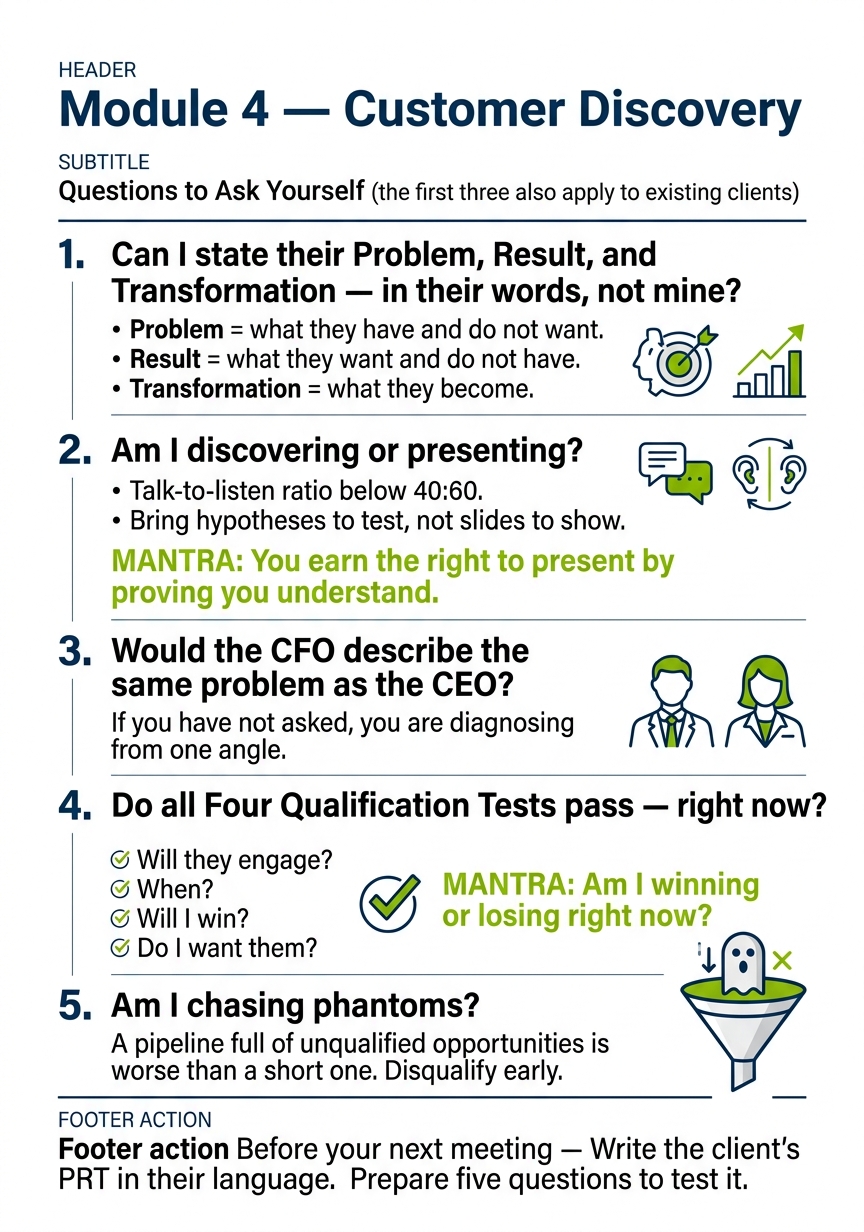
Questions to Ask Yourself (the first three also apply to existing clients)
1. Can I state their Problem, Result, and Transformation — in their words, not mine?
Problem = what they have and do not want. Result = what they want and do not have. Transformation = what they become.
2. Am I discovering or presenting?
Talk-to-listen ratio below 40:60. Bring hypotheses to test, not slides to show.
You earn the right to present by proving you understand.
3. Would the CFO describe the same problem as the CEO?
If you have not asked, you are diagnosing from one angle.
4. Do all Four Qualification Tests pass — right now?
Will they engage? When? Will I win? Do I want them? Am I winning or losing right now?
5. Am I chasing phantoms?
A pipeline full of unqualified opportunities is worse than a short one. Disqualify early.
Stakeholder Management
Navigate complex buying groups. Five buyer types, the WHY/HOW partnership, and managing the people behind the table.
Learning Objectives
By the end of this module, you will be able to:
- Map the full Decision-Making Unit for every advisory engagement using the Five Buyer Types framework — identifying Strategic, Financial, User, Technical, and Coach stakeholders before they surface as blockers
- Diagnose whether your CEO client is a WHY-type or HOW-type leader and position your advisory relationship as the complementary partnership they need
- Facilitate client leadership decisions using the Throne Behind the Round Table model — creating ensemble debate while holding decisive backstop authority
- Recognise when a stalled engagement is caused by an unmapped stakeholder rather than a flawed recommendation
- Build and maintain a Coach inside every client organisation who accelerates your influence and warns you of invisible resistance
Core Concept 1: The Throne Behind the Round Table — Facilitating Decisive Leadership
The Model
THE THRONE BEHIND THE ROUND TABLE
===================================

              +============================+
              |                            |
              |       ROUND TABLE          |
              |                            |
              |  All voices heard equally  |
              |  Best idea wins (80%)      |
              |  Debate, not disagreement  |
              |                            |
              +============================+
                          |
                  [If impasse]
                          |
                          v
              +-------------------+
              |                   |
              |      THRONE       |
              |                   |
              |  Leader decides   |
              |  (20% of cases)   |
              |  “Done.”          |
              |                   |
              +-------------------+
                          |
                          v
              +-------------------+
              |                   |
              |  COMMITMENT SEAL  |
              |                   |
              |  Everyone rallies |
              |  No back-channel  |
              |  Full execution   |
              |                   |
              +-------------------+

   FLOW: Air all opinions --> Seek best idea
         --> If impasse --> Leader decides
         --> Everyone commits.
The Contrast: Most fractional CTOs either default to presenting recommendations and expecting the CEO to accept them, or they facilitate meetings where every stakeholder has a voice but no decision ever gets made. The first approach makes you a dictator. The second makes you a passenger. Neither earns the trust that sustains a long-term advisory relationship.
The Principle: The best decisions emerge from an ensemble process where every perspective is aired openly — but there must always be someone ready to break ties when the group cannot converge. Bill Campbell, the legendary Silicon Valley coach, observed that eight out of ten times a well-run team will reach the best answer on their own. The other two times, someone must stand, make the call, and expect full commitment. This is not democracy. It is not dictatorship. It is guided consensus with a decisive backstop.
The Tool: The Round Table and Throne model. As a fractional CTO, you facilitate the round table — ensuring all voices surface during leadership discussions. You coach the CEO on when to activate the throne — stepping in decisively when the team cannot converge. And you enforce the commitment seal — ensuring that once a decision is made, dissent stops and execution begins. The Rule of Two is your intermediate step: before escalating to the throne, assign the two people closest to the disagreement to collaborate on a recommendation.
Examples for advisory professionals:
- A fractional CTO facilitates a technology investment debate between the CEO and CFO, ensuring both perspectives are fully aired before the CEO makes the final call
- During a digital transformation steering committee, you notice two department heads are entrenched. You invoke the Rule of Two: “You both have valid concerns. Go away, gather the data, and come back with a joint recommendation by Thursday.”
- A CEO has been avoiding a vendor decision for three weeks. You say: “Your team has debated this thoroughly. Eight out of ten times they would converge. This is one of the other two. It is time to decide.”
The Orchestra Conductor: Think of the fractional CTO as an orchestra conductor. Ninety percent of the time, the musicians play together, listening to each other, creating music no single person could produce alone. The conductor does not play a note. But they set the tempo, bring in sections at the right moment, and — when two sections pull in different directions — give the definitive downbeat that resolves the tension. Remove the conductor and you get noise. Remove the musicians and you get silence. The genius of a great conductor is that the audience forgets they are there — until the moment when everything depends on that single, decisive gesture.
Case Study: The Steering Committee That Would Not Steer
Rachel had been advising NorthStar Logistics as their fractional CTO for four months. The CEO, David, had assembled a steering committee for a major ERP replacement — himself, the CFO Helen, the operations director, the IT manager, and Rachel.
The problem was simple: the committee met fortnightly but never decided anything. Each meeting produced vigorous debate, agreement to “think about it further,” and a polite adjournment. The ERP vendor shortlist had not moved in six weeks. David was frustrated but kept hoping the next meeting would produce consensus.
Rachel recognised the pattern. After the fourth inconclusive session, she asked David for a private word. “David, your round table is working beautifully — every voice is being heard. But the throne is empty. Helen has legitimate cost concerns. Operations has legitimate timeline concerns. They will not converge on their own. This is the twenty percent where you need to make the call.”
David resisted. “I do not want to override anyone.”
“You are not overriding them. You have heard every perspective. Now you are doing the part of the job only you can do — deciding. And once you do, everyone will rally. That is how this works.”
David called a final meeting. He summarised each stakeholder’s position to prove he had listened. Then he chose the vendor, set the timeline, and said: “This is the direction. I need everyone’s full commitment.”
Helen, who had argued hardest against the chosen vendor, was the first to say: “Right. Let me work the numbers to make this succeed.”
The project launched the following Monday. Six weeks of paralysis resolved in one decisive moment.
“I thought my job was to build consensus,” David told Rachel. “You showed me my job was to build conditions for the best debate — and then have the courage to end it.”
Practice Exercise
Before your next client steering committee or leadership meeting:
- Draw the Round Table and Throne model on a notepad. Identify which stakeholders need a voice at the table and which decision requires the CEO’s throne
- During the meeting, track whether all perspectives have surfaced. Note any stakeholder who has not spoken — they may be the most important voice
- If the discussion reaches an impasse, suggest the Rule of Two: ask the two closest stakeholders to collaborate on a joint recommendation before escalating
- After the meeting, reflect: was the throne activated when needed, or did the group adjourn without deciding? If the latter, raise it privately with the CEO
Core Concept 2: The WHY-HOW Partnership — Positioning Your Advisory Relationship
The Model
THE WHY-HOW PARTNERSHIP
========================

     WHY-TYPE (CEO)                    HOW-TYPE (Advisor)
   +------------------+             +------------------+
   |                  |             |                  |
   |  Sees the FUTURE |             |  Sees the PRESENT|
   |                  |             |                  |
   |  Imagines what   |   TRUST &  |  Builds what     |
   |  could be        |<-- SHARED -->|  must be done    |
   |                  |   VALUES   |                  |
   |  Inspires belief |             |  Implements      |
   |                  |             |  systems         |
   +------------------+             +------------------+
          |                                |
          v                                v
    VISION STATEMENT               MISSION STATEMENT
    (WHY we exist)                 (HOW we get there)

   WHY without HOW = Starving Visionary
   HOW without WHY = Successful but Uninspiring
   WHY + HOW       = Transformative

   THE FRACTIONAL CTO POSITION:
   ============================
   Most CEOs are WHY-types.
   They need a HOW-type partner.
   That is your seat at the table.
The Contrast: Most fractional CTOs position themselves as technical experts — someone who knows the answers to technology questions. This positions you as a supplier of knowledge, easily replaced by the next expert with a sharper CV. You become a cost centre, not a partner.
The Principle: Every great movement, company, or achievement results from a partnership between a WHY-type (the visionary who sees the future) and a HOW-type (the builder who creates the systems to make the vision real). Walt Disney needed Roy Disney. Steve Jobs needed Steve Wozniak. Martin Luther King Jr. needed Ralph Abernathy. Most CEOs are WHY-types — they see the future but struggle with the operational mechanics of getting there. As a fractional CTO, your highest-value position is as their HOW-type partner — the person who translates vision into architecture, strategy into roadmap, and aspiration into execution.
The Tool: The WHY-HOW Partnership Assessment. Diagnose your CEO client’s type (most are WHY-types: future-focused, idea-driven, inspired by possibility). Then explicitly position your advisory relationship as the complementary partnership: “You set the direction. I build the road.” This transforms you from a hired expert into an indispensable partner. The trust bridge between WHY and HOW is built on shared values, not shared skills.
Examples for advisory professionals:
- A CEO client describes a vision for AI transformation but cannot articulate the steps. You say: “That is the WHY. My job is the HOW. Let me translate that vision into a twelve-month roadmap you can take to the board.”
- You notice a CEO keeps launching new initiatives before the last one is finished. Instead of frustration, you recognise the WHY-type pattern and adapt: “Your instinct for what is next is your superpower. My job is to build the systems that let each initiative land before the next one launches.”
- A CEO is about to hire a CTO full-time. You advise: “You need someone who complements you, not duplicates you. You are the compass. You need a map.”
The Compass and the Map: A WHY-type CEO is a compass — they know which direction to go but cannot tell you the roads to take. A HOW-type fractional CTO is a map — showing every road, every turn, every obstacle, but needing the compass to know which direction matters. A compass without a map leads to wandering in the right direction. A map without a compass leads to efficient travel to nowhere. When Walt Disney dreamed of animated feature films, everyone called it foolish. His brother Roy did not argue. He just found the financing, built the distribution system, and kept the lights on. Walt would have been a brilliant dreamer whose cartoons never reached an audience. Roy would have been a successful banker whose career changed nothing. Together, they built an empire that has shaped global culture for a century. That is what happens when the compass and the map find each other.
Case Study: The CEO Who Kept Launching Rockets
Tom, CEO of a mid-market insurance technology firm, had hired three fractional CTOs in two years. Each lasted about six months before the relationship broke down. The pattern was always the same: Tom would share an exciting new technology direction, the advisor would begin building it, and before the first milestone was reached, Tom had pivoted to something else entirely. Each advisor left feeling Tom was impossible to work with.
When Elena joined as his fourth fractional CTO, she recognised the pattern within a fortnight. Tom was a classic WHY-type — visionary, optimistic, endlessly generating ideas, and constitutionally unable to sit still while things were being built. His previous advisors had all been HOW-types who tried to slow him down. The clash was inevitable.
Elena did something different. In their third meeting, she drew two boxes on the whiteboard. “Tom, you are a compass. You always know which direction is north. That is extraordinary — most companies would kill for a leader with your instinct. But a compass cannot build a road. That is my job. Here is what I propose: you keep pointing north. I will build the road. And when you want to change direction, you tell me first — not the team — and we decide together whether it is a pivot or a distraction.”
Tom stared at the whiteboard for ten seconds. “Nobody has ever explained it like that before. They all just told me to stop changing my mind.”
“I do not want you to stop changing your mind. I want us to change it together.”
Elena lasted eighteen months — the longest advisory engagement in Tom’s company history. Three major technology initiatives were delivered to completion. Not because Tom stopped being a WHY-type, but because he finally had a HOW-type who understood that her job was not to contain his vision but to channel it.
“She did not try to fix me,” Tom said. “She completed me.”
Practice Exercise
For your current or next advisory engagement:
- Diagnose your CEO client’s type using the WHY/HOW reference signals: Do they talk about where we are going (WHY) or how to get there (HOW)? Do they energise rooms with possibility or with concrete plans?
- Write one sentence describing your role as their complement: “You are the [WHY/HOW]. I am the [HOW/WHY]. Together we [outcome].”
- In your next meeting, test the framing. Use the compass-and-map metaphor if the CEO is a WHY-type. Watch how they respond to being seen as a visionary rather than someone who needs to be managed
- Score your current partnership health across three dimensions: shared purpose (1-5), role clarity (1-5), and communication rhythm (1-5). Address the lowest score first
Core Concept 3: The Five Buyer Types — Mapping Your Client’s Decision-Making Unit
The Model
THE FIVE BUYER TYPES IN ADVISORY ENGAGEMENTS
=============================================

                   STRATEGIC BUYER (CEO)
                  “How does this make us
                   stronger as a business?”
                         /\
                        /  \
                       /    \
   COACH /           /      \           \ FINANCIAL
   ADVOCATE         /        \            BUYER (CFO)
  (Internal        /          \          “What is the
   Champion)      /            \          return on this
  “Let me help   /              \         advisory spend?”
   you navigate”/                \
              /  +==============+  \
             /   |              |   \
            /    |   ADVISORY   |    \
           /     |   MANDATE    |     \
          /      |   DECISION   |      \
         /       +==============+       \
        /                                \
   USER BUYER                        TECHNICAL
  (Department Heads)                 BUYER (IT Lead)
 “Will this advisor                 “Does this person
  understand MY                      know our stack
  problems?”                         and landscape?”

  MISS ONE = Engagement at risk
  MAP ALL  = Mandate secured
  FIND THE COACH = Expansion enabled
The Contrast: Most fractional CTOs build their relationship with the CEO and assume that is sufficient. They prepare for the CEO meeting, deliver their recommendations to the CEO, and treat the CEO as the sole decision-maker. Then they are blindsided when the CFO questions the advisory spend, a department head undermines their recommendations, or the IT manager quietly resists their architecture proposals. The deal — or the engagement renewal — dies in a room they were never invited into.
The Principle: Every significant decision in a client organisation involves five distinct buyer types, each with different priorities, different fears, and different definitions of value. The CEO (Strategic Buyer) cares about systemic impact. The CFO (Financial Buyer) cares about ROI. Department heads (User Buyers) care about whether your recommendations make their lives easier or harder. The IT lead (Technical Buyer) cares about whether your proposals work in their existing landscape. And somewhere inside the organisation sits a Coach — an internal champion who provides intelligence, opens doors, and warns you when you are about to make a fatal mistake. Miss one voice and your engagement is at risk.
The Tool: The Decision-Making Unit Map. For every advisory engagement, identify all five buyer types by name, role, and core concern. Create a tailored message for each: a strategic alignment brief for the CEO, an ROI framework for the CFO, a practical impact assessment for department heads, a technical compatibility review for the IT lead, and regular intelligence exchanges with your Coach. The mantra is simple: map the unit, secure the mandate.
Examples for advisory professionals:
- A fractional CTO’s engagement is up for renewal. The CEO is enthusiastic, but the CFO has been asking pointed questions about ROI. You prepare a business case with measurable outcomes specifically for the CFO — a document the CEO would never have requested but the CFO needs to say yes
- You discover that the IT manager has been quietly telling department heads that your cloud migration proposal will not work with their legacy systems. Instead of going to the CEO, you sit down with the IT manager directly: “Walk me through your concerns. I want to make sure this works in your world.”
- A project manager inside the client has been feeding you intelligence about internal politics. You recognise them as your Coach and invest time in the relationship: regular coffee chats, advance previews of your recommendations, and genuine gratitude for their navigation
The Orchestra Without a Score: Advising into a client organisation is like conducting an orchestra where you have not been given the full score. You can hear the CEO clearly because they sit at the front — that is the person who hired you. But behind them sit the CFO, the department heads, the IT team, and the informal influencers. Each section plays a different part. If you conduct only for the CEO, the rest of the orchestra goes silent — or worse, plays against you. A great conductor makes eye contact with every section. They understand what each part contributes. They know that the tuba player in the back corner can derail the entire symphony if ignored. In advisory, this means mapping every stakeholder, understanding their individual concerns, and composing your advisory approach so that every section hears their part in the melody.
Case Study: The Engagement That Nearly Died in Finance
Marcus had been advising CloudFirst, a fast-growing SaaS company, as their fractional CTO for eight months. His relationship with the CEO, Priya, was excellent. She valued his strategic thinking, trusted his technology recommendations, and had just asked him to present a major infrastructure investment to her leadership team.
Marcus prepared a thorough proposal — architecture diagrams, vendor comparisons, implementation timeline. He presented it to the leadership meeting. Priya nodded throughout. The operations team were enthusiastic. The IT lead confirmed technical feasibility.
Then the CFO, James, spoke. “I appreciate the thoroughness. But I need to understand the return. What is the payback period? What does the cost-of-doing-nothing model look like? And frankly, I have been wanting to ask this for months — what is the measurable ROI on this advisory engagement overall?”
Marcus felt the floor shift. He had never spoken to James directly. He had never prepared a financial case. He had assumed that Priya’s enthusiasm was sufficient.
After the meeting, Marcus called his practice lead. “I almost lost the engagement today. Not because my work was wrong — because I only spoke to one buyer type. The CFO has been sitting in an empty chair for eight months.”
The following week, Marcus requested a one-to-one with James. He brought a simple ROI model for the infrastructure investment and a retrospective value assessment for his eight months of advisory work. James studied the numbers, asked sharp questions, and then said something Marcus did not expect: “This is good work. I wish someone had shown me this months ago. I have been arguing with Priya about your engagement because nobody gave me the data to support it.”
Marcus identified his Coach two days later — Priya’s executive assistant, who knew every stakeholder’s concerns and was willing to share them quietly. He mapped the remaining buyer types and began tailoring his communications for each one.
His engagement was renewed for a further twelve months — unanimously.
“I stopped advising the CEO,” Marcus said. “I started advising the organisation.”
Practice Exercise
For your current advisory engagement:
- Draw five columns on a page: Strategic (CEO), Financial (CFO), User (Department Heads), Technical (IT Lead), Coach (Internal Champion). Write the name of each person in your client organisation
- Traffic-light each column: GREEN if you have met them and understand their priorities. AMBER if you know who they are but have not engaged directly. RED if the chair is empty — you have not identified anyone
- For every AMBER and RED, write one specific action to turn it green within the next fortnight. What conversation do you need to have? What document do you need to prepare?
- Identify your Coach. If you do not have one, your highest-priority action is finding one. Ask yourself: who inside the client is invested in my success and willing to share intelligence?
Synthesis: How the Three Concepts Connect
STAKEHOLDER MANAGEMENT SEQUENCE
=================================

STEP 1: MAP THE UNIT          STEP 2: POSITION             STEP 3: FACILITATE
(Five Buyer Types)             YOURSELF                     DECISIONS
                               (WHY-HOW Partnership)        (Throne Behind the
                                                             Round Table)

+------------------+          +------------------+          +------------------+
|                  |          |                  |          |                  |
| Who are all the  | ------> | Where do I sit   | ------> | How do I help    |
| stakeholders?    |          | in this system?  |          | them decide?     |
|                  |          |                  |          |                  |
| Strategic        |          | I am the HOW to  |          | Round Table:     |
| Financial        |          | the CEO’s WHY    |          |   all voices     |
| User             |          |                  |          | Throne:          |
| Technical        |          | Trust bridge     |          |   decisive call  |
| Coach            |          | built on shared  |          | Commitment Seal: |
|                  |          | values           |          |   unified action |
+------------------+          +------------------+          +------------------+

       MAP                         PARTNER                      DECIDE
These three concepts form an integrated stakeholder management system for fractional CTOs. They answer three questions: Who are you advising? How do you position yourself? And how do you help them decide?
The Five Buyer Types answer the first question: you are not advising one person. You are advising an organisation with multiple stakeholders, each with different priorities. Map them all or lose to the voice you never heard.
The WHY-HOW Partnership answers the second question: position yourself as the CEO’s complementary partner, not their hired expert. You are the builder to their visionary, the map to their compass. This transforms a transactional advisory relationship into an indispensable partnership.
The Throne Behind the Round Table answers the third question: help your CEO facilitate decisions that stick. Create the conditions for ensemble debate, coach them on when to activate decisive authority, and enforce the commitment seal that turns debate into action.
The Progression: The sequence matters. You cannot facilitate decisions effectively (Step 3) until you have positioned yourself as a trusted partner (Step 2). And you cannot position yourself until you have mapped the full stakeholder landscape (Step 1). Start with the map. Build the partnership. Then help them decide.
Crib Sheet
Step 1: Map the Decision-Making Unit (Five Buyer Types)
Five chairs must be filled: Strategic (CEO), Financial (CFO), User (department heads), Technical (IT lead), Coach (internal champion). Miss one and the engagement dies in a room you were never invited into.
Map the unit. Secure the mandate.
Step 2: Position as the WHY-HOW Partner
Most CEOs are WHY-types — they see the future but cannot build the road. You are the HOW-type complement: “You set the direction. I build the road.” This transforms you from hired expert to indispensable partner.
Step 3: Build a Stakeholder Blueprint
For every stakeholder, answer four questions: What do they need to achieve? How do they prefer to communicate? What do you need from them? What message do you send them? Traffic-light each one (green/amber/red). Any red chair is your priority this week.
Tailor the message. Work the map.
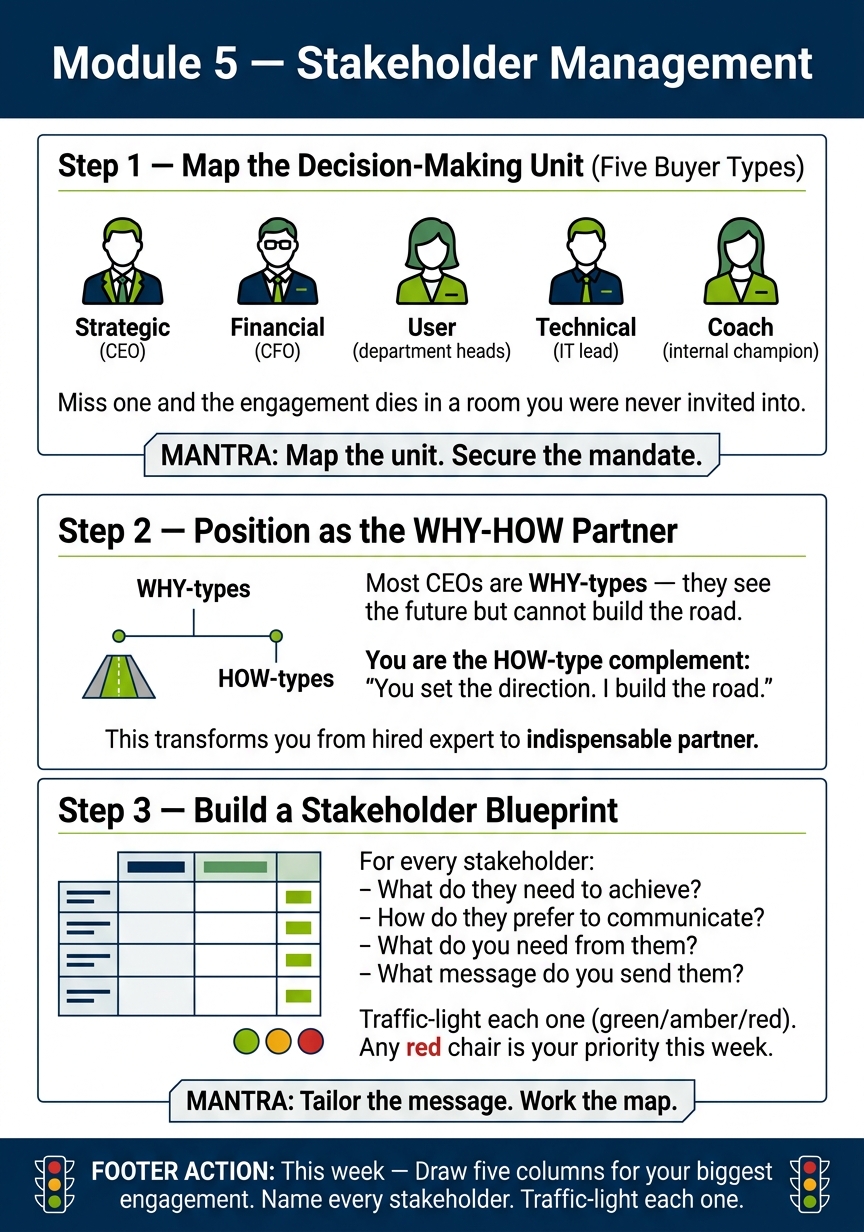
Building Trust
The capstone. Tactical empathy, the accusation audit, and the frameworks that turn first meetings into lasting relationships.
Learning Objectives
By the end of this module, you will be able to:
- Deploy the Tactical Empathy Stack to demonstrate deep understanding of your client’s perspective before making any recommendation or ask
- Prepare and deliver an Accusation Audit that preemptively defuses client concerns and objections before they surface
- Diagnose the health of any client relationship using the five elements of the Envelope of Trust — Word, Loyalty, Integrity, Ability, and Discretion
- Recognise the difference between “That’s right” (genuine breakthrough) and “You’re right” (polite dismissal), and adjust your approach accordingly
- Build a sealed trust envelope within the first engagement, rather than waiting months for trust to accumulate passively
Core Concept 1: The Tactical Empathy Stack
The Model
THE TACTICAL EMPATHY STACK
===========================

+---------------------------------------+
|  5. SUMMARY / PARAPHRASE              |  “That’s right” — the breakthrough
+---------------------------------------+
              |
+---------------------------------------+
|  4. ACCUSATION AUDIT                  |  Preempt negatives before they land
+---------------------------------------+
              |
+---------------------------------------+
|  3. LABELING                          |  Name the emotion to defuse it
+---------------------------------------+
              |
+---------------------------------------+
|  2. TACTICAL EMPATHY                  |  Understand feelings + what’s behind
+---------------------------------------+
              |
+---------------------------------------+
|  1. ACTIVE LISTENING                  |  Talk less, hear more. DJ voice.
+---------------------------------------+

FOUNDATION -----------> BREAKTHROUGH
(Bottom)                  (Top)

Each layer enables the one above it.
Skip a layer and the stack collapses.
Explanation
The Contrast: Most fractional CTOs prepare for client meetings by assembling evidence — dashboards, architecture diagrams, risk registers. They assume that if the logic is sound, the CEO will agree. But CEOs are not logic processors. They are human beings running on emotion first, reason second. The advisor who leads with logic before establishing emotional understanding is a doctor prescribing treatment without an X-ray.
The Principle: Emotions are not obstacles to agreement. They are the means. When you demonstrate genuine understanding of what your client feels — and what lies beneath those feelings — you earn the right to influence. Tactical empathy is not about being nice or agreeing. It is the disciplined practice of understanding another person’s perspective so completely that they feel heard at a level they have never experienced from an advisor before.
The Tool: The Tactical Empathy Stack is a five-layer process, built from the bottom up. Layer 1: Active Listening — full attention, late-night DJ voice, no internal monologue competing. Layer 2: Tactical Empathy — understanding both the feeling and the reason behind it. Layer 3: Labeling — naming the emotion aloud using “It seems like…” or “It sounds like…” followed by silence. Layer 4: Accusation Audit — preempting every negative thought the client might hold about you. Layer 5: Summary/Paraphrase — bundling their world back to them so completely that they say “That’s right.”
Examples for advisory professionals:
- A CEO says “The board is breathing down my neck on this transformation.” You label: “It sounds like you are carrying the weight of a promise the board expected to see delivered by now.” Then silence.
- A CFO challenges your fees in a review meeting. Instead of defending your value, you say: “It seems like you are not yet seeing the return that would justify this investment.” Wait. Let the label land.
- In a first meeting, the CEO mentions a failed technology project. You say: “It looks like that experience made it harder to trust external advisors.” The CEO leans forward.
The Emotional X-Ray: Think of tactical empathy as an X-ray machine for the human mind. A doctor does not treat a fracture by guessing — she uses imaging to see exactly where the break lies beneath the surface. Only then can she set the bone properly. Active listening is the hardware. Tactical empathy is reading the image. Labeling is showing the image to the patient: “Here — this is what I see.” The accusation audit addresses their fears about surgery before they voice them. And the summary is the treatment plan that earns consent. You do not need to agree with the patient’s self-diagnosis. You simply need to see what is actually there and articulate it with precision.
Case Study: The Frustrated CEO
Rachel had been a fractional CTO for five years. Technically brilliant. But she kept losing engagements after six months. Clients respected her recommendations but never fully committed to them. Her practice lead, Tom, watched her in a client meeting and saw the problem immediately: Rachel was solving before she was understanding.
Her client, David, was the CEO of a logistics company. His board had approved a digital transformation eighteen months ago. It was behind schedule, over budget, and David’s credibility was on the line. Rachel had prepared a revised technical roadmap — thorough, logical, correct.
She was about to present it when Tom’s coaching from that morning echoed: “Before you show him the solution, show him you understand his problem. Not the technical problem. His problem.”
Rachel set the slides aside. She lowered her voice and said: “It seems like you are in a position where the board approved something that made sense eighteen months ago, and now you are the one they are looking at when the numbers do not match the promise.”
David went still. Then he exhaled. “That is exactly it. Nobody on my team will say that out loud. They just keep telling me we are nearly there.”
Over the next forty minutes, David shared things Rachel had never heard in six months of meetings — his real concerns about two key hires, his doubts about the vendor, his fear that the board would pull funding before the platform delivered. Rachel had been given the X-ray. Everything she recommended after that point landed differently.
Three months later, the programme was back on track. David renewed the engagement for another year.
“She stopped solving my technology problem and started understanding my actual problem. That is when everything changed.”
Practice Exercise
Before your next client meeting:
- Write down what you believe the client is feeling about the situation — not the technical facts, but the emotional reality. What keeps them up at night? What are they afraid of?
- Prepare three labels using the stems “It seems like…”, “It sounds like…”, or “It looks like…” — each addressing one of those emotional realities
- In the meeting, deploy one label within the first ten minutes. After delivering it, count silently to five. Do not fill the silence.
- After the meeting, record what the client said in response to the label. Did they correct you, elaborate, or reveal something new?
Core Concept 2: The Accusation Audit
The Model
THE ACCUSATION AUDIT FUNNEL
============================

BEFORE THE CONVERSATION
========================

Step 1: LIST
+----------------------------------+
|  Every terrible thing the client |
|  could think or say about you    |
|  (accusations, fears, doubts)    |
+----------------------------------+
            |
            v
Step 2: LABEL
+---------------------------+
|  Convert each accusation  |
|  into a label:            |
|  “You probably think…”  |
|  “It seems like…”       |
+---------------------------+
            |
            v
Step 3: LEAD
+-----------------------+
|  Deliver labels at    |
|  the OPENING of the   |
|  conversation BEFORE  |
|  they accuse you      |
+-----------------------+
            |
            v
THE CLIENT’S RESPONSE
======================
“No, no — that is not what
 we think at all…”
(They REASSURE you)

+-----------------------+
|  CLEARED ROAD:        |
|  Negativity defused   |
|  Trust established    |
|  Real conversation    |
|  can begin            |
+-----------------------+
Explanation
The Contrast: Most advisors walk into difficult conversations hoping the client will not raise the uncomfortable topics. They prepare their defence for when the accusation lands. This is backwards. The accusations are already running in the client’s head. Ignoring them does not make them disappear — it lets them harden into conviction. The longer they go unspoken, the more powerful they become.
The Principle: When you voice an accusation before the other person can deploy it, you strip it of its power. The accusations almost always sound exaggerated when spoken aloud, which triggers a psychological reflex: instead of attacking you, the client rushes to reassure you that you are not as bad as you just described. The emotional road clears. The real conversation can begin.
The Tool: The Accusation Audit follows a three-step sequence: List, Label, Lead. Before the meeting, list every terrible thing the client could think about you. Convert each into a label using third-person framing. Then deliver those labels at the very opening of the conversation, before the client can voice them. The sequence matters: acknowledge the negative before introducing your ask.
Examples for advisory professionals:
- Starting a fee review: “You probably think we have been billing aggressively without enough visible progress to justify the cost. It might seem like we prioritised our methodology over your actual business needs.”
- Joining a project that had a previous failed advisor: “It seems like your experience with the last technology advisor made it harder to trust that this engagement will be different. You might feel like we are just the next firm making promises.”
- Delivering unwelcome news about a timeline slip: “It looks like we are about to confirm your worst fear — that this programme is slipping further. You probably think we should have flagged this sooner.”
The Controlled Burn: Think of the accusation audit as a controlled burn that firefighters set before wildfire season. A forest ranger surveys the landscape thick with dead wood and dry grass. She knows that if lightning strikes in July, the whole mountain could go up. So in early spring, she lights small, deliberate fires. She chooses where. She chooses when. She controls the perimeter. The dead wood burns away cleanly. And when summer comes, there is nothing left to fuel a wildfire. That is exactly what you do with client negativity. By voicing every accusation yourself — under controlled conditions, on your terms — you burn away the emotional fuel before the real conversation starts. The accusations, once spoken aloud, almost always sound exaggerated. And the client rushes to douse them: “No, no, that is not what we think at all.”
Case Study: The Fee Challenge
Marcus had been advising the CEO of a mid-market manufacturer, Elena, for nine months. The engagement was producing results — a new ERP platform was live, the data architecture was sound — but the board had asked Elena to review all advisory costs. Marcus knew what was coming. He also knew that if he waited for Elena to raise it, the conversation would start on the back foot.
The night before the meeting, Marcus sat down and wrote every accusation Elena’s board might be feeding her. “He charges too much for what is essentially project management.” “We could hire a permanent CTO for the same money.” “He has a conflict of interest — the longer the project runs, the more he earns.” “He is not strategic enough for what we are paying.”
He converted each into a label. The next morning, he opened the meeting before Elena could speak.
“Elena, I know the board asked you to review advisory costs, and I want to address what I imagine might be in the room. You probably think that what I do could be handled by a permanent hire at a lower total cost. It might seem like I have a financial incentive to stretch the engagement. And it could look like the strategic impact has not yet matched the investment.”
Elena leaned back. “Honestly, Marcus, the board did say some of those things. But hearing you say them — you clearly get it. And most of them are not quite right.”
Over the next hour, Elena shared what the board actually said — which was more nuanced than Marcus had feared. Two concerns were legitimate and he addressed them with data. One was a misunderstanding he corrected on the spot. The engagement continued. The board approved another six months.
“He did not wait for me to be the bad guy. He took it on himself. That changed the whole conversation.”
Practice Exercise
Before your next difficult client conversation:
- Write down five accusations the client (or their board, or their CFO) could level at you. Do not filter or soften. The more uncomfortable they feel to write, the more powerful they will be when deployed.
- Convert each into a label using “It seems like…”, “It probably looks like…”, or “You might feel that…” — no “I” statements, no apologies
- Rank them by emotional intensity. Plan your delivery sequence — either most charged first (defuse the elephant) or general to specific (ease in gradually)
- Rehearse the opening sixty seconds aloud. Check: is your tone empathetic, not apologetic? Are you naming, not confessing?
Core Concept 3: The Envelope of Trust
The Model
THE FIVE-SIDED ENVELOPE
========================

                   WORD
                  /    \
                 /      \
                / THE    \
         LOYALTY ENVELOPE INTEGRITY
               \ OF TRUST /
                \        /
                 \      /
           DISCRETION--ABILITY

================================
WHAT LIVES INSIDE THE ENVELOPE:
================================
- Psychological Safety
- Productive Disagreement
- Honest Feedback
- Courageous Decision-Making
- Extraordinary Performance

BUILD ORDER:
1. Word       (reliability)
2. Loyalty    (commitment)
3. Integrity  (honesty)
4. Ability    (competence)
5. Discretion (confidentiality)
================================

One missing side = envelope tears open.
Everything inside leaks out.
Explanation
The Contrast: Most advisors believe trust is earned slowly over time through accumulated proof of competence. They treat trust as a byproduct of good work — deliver enough results and the client will eventually trust you. This is passive and dangerously slow. In fractional CTO engagements where you may have six to twelve months to make an impact, waiting for trust to accumulate organically means you spend half the engagement operating without the psychological safety needed for honest conversations.
The Principle: Trust is not one thing. It is five things working together: Word (you do what you say), Loyalty (you stand with the client through difficulty), Integrity (you tell the truth even when it is uncomfortable), Ability (you demonstrably know what you are doing), and Discretion (what the client shares with you stays with you). Remove any single element and the envelope tears open. Everything inside it — psychological safety, honest feedback, courageous decisions — leaks out.
The Tool: The Envelope of Trust is a five-element framework that you build deliberately, starting from your first interaction. Audit each element for every client relationship. Where is the envelope sealed? Where is it torn? Which single element, if strengthened, would have the greatest impact? The build order matters: Word first (keep small promises immediately), then demonstrate each subsequent element through specific, observable actions.
Examples for advisory professionals:
- Word: You say “I will send you a summary by Thursday.” You send it by Wednesday. Every time. Small promises kept build the seal.
- Loyalty: The CEO’s strategy is challenged in a board meeting. You say publicly: “I have reviewed the data and I support this direction. Here is why.” Not privately after the meeting. In the room.
- Discretion: The CEO shares that two board members are privately lobbying against the transformation. You never mention this to anyone — not to the project team, not to your practice lead, not to your own partner at dinner. That information stays sealed.
The Sealed Envelope: Imagine you need to send the most valuable document of your career — one that contains your real assessment of what is broken and what could be built. You would not stuff it into a torn envelope. You would not use an envelope with only three sides. You would find one with all five sides intact, seal it carefully, and hand it to someone whose reliability, loyalty, honesty, competence, and discretion you were confident in. Bill Campbell, the coach to Steve Jobs, Eric Schmidt, and Sheryl Sandberg, built this envelope with every person he coached — often in the first meeting. He demonstrated all five elements immediately: keeping his word on small promises, expressing genuine loyalty, being brutally honest, showing real competence, and making it clear that anything shared with him would stay with him. A fractional CTO can do the same. You do not need years. You need intentionality.
Case Study: The Torn Envelope
Priya had been advising James, CEO of a fintech company, for four months. The engagement was technically productive — infrastructure modernisation was on track, the DevOps pipeline was maturing. But something was off. James gave Priya polished updates in their weekly calls. He never pushed back on her recommendations. He never shared bad news first. Priya recognised the pattern: compliance without contribution. The envelope was torn somewhere.
She mapped the relationship against the five elements. Word: strong — both sides kept commitments. Ability: strong — James respected her technical judgment. Integrity: she had been honest about timelines and risks. Loyalty: untested — no moment of difficulty had required it yet.
Then she found it. Discretion.
Three months earlier, James had mentioned — casually, almost as an aside — that his co-founder was considering leaving. Priya had used that information in a planning document, framing a risk around “key person dependency.” She had not named the co-founder. But James had noticed. And he had stopped sharing anything sensitive.
Priya addressed it directly in their next call. “James, I want to raise something. A few months ago, you mentioned something about your co-founder in confidence, and I think I used that context in a planning document without checking with you first. It was a misstep. I should have asked. And I want you to know — nothing you share with me will appear in any document or conversation without your explicit agreement.”
James was quiet for a moment. Then: “I appreciated that you raised it. Honestly, I had been holding back. That one thing made me careful about everything.”
Over the next month, the dynamic shifted. James started sharing the real picture — the board tensions, the hiring challenges, the doubts about a key vendor. The envelope re-sealed. Priya could finally advise on what actually mattered.
“She did not wait for me to confront her. She named it herself. That is what made me trust her again.”
Practice Exercise
For your most important current client relationship:
- Score the relationship on each of the five elements (Word, Loyalty, Integrity, Ability, Discretion) from 1 to 5. Be honest — this is private.
- Identify the lowest-scoring element. This is the torn side of the envelope.
- Write one specific action you could take in the next seven days to strengthen that element. Make it concrete: a promise to keep, a truth to deliver, a confidence to protect.
- After taking the action, re-score the element. Track whether the client’s behaviour shifts — are they sharing more openly? Pushing back more freely? That is the envelope re-sealing.
Synthesis: How These Concepts Connect
The three concepts in this module form a progressive trust-building sequence. Tactical empathy is how you demonstrate understanding. The accusation audit is how you clear the emotional road. The envelope of trust is the container you build to hold everything that follows.
Think of it as a construction project. Tactical empathy lays the foundation — you cannot build on ground the client does not believe you understand. The accusation audit clears the site — removing the debris of unspoken fears and negative assumptions that would undermine the foundation. And the envelope of trust is the structure itself — five walls that must all stand for the building to hold.
The sequence matters. You cannot seal the envelope without first demonstrating empathy. You cannot run an effective accusation audit without first listening deeply enough to know what the client might be thinking. And you cannot sustain trust over a six-month or twelve-month engagement without deliberately maintaining all five elements of the envelope.
THE TRUST-BUILDING SEQUENCE
============================

MEETING 1                    ONGOING                      SUSTAINED
---------                    -------                      ---------

+------------------+    +------------------+    +------------------+
|                  |    |                  |    |                  |
| TACTICAL EMPATHY | -> | ACCUSATION AUDIT | -> | ENVELOPE OF     |
|                  |    |                  |    | TRUST            |
| “I understand    |    | “I know what you |    |                 |
|  your world”     |    |  might fear”     |    | All 5 elements  |
|                  |    |                  |    | sealed and       |
| Demonstrate      |    | Clear the road   |    | maintained       |
| understanding    |    | of negativity    |    |                  |
+------------------+    +------------------+    +------------------+

RESULT: The client shares the truth, accepts hard feedback,
and commits to decisions — because the trust container holds.
When all three work together, something remarkable happens: the client stops managing you and starts collaborating with you. They share the real picture. They accept uncomfortable truths. They make courageous decisions. Not because you are persuasive, but because they trust you. And trust, once sealed, becomes the most powerful asset in your advisory practice.
Crib Sheet
1. The Tactical Empathy Stack — Understand Before You Influence
Five layers, bottom up: Active Listening, Tactical Empathy, Labelling, Accusation Audit, Summary. Skip a layer and the stack collapses. Label emotions with “It seems like…” then hold silence for five seconds. Aim for “That’s right” (breakthrough), not “You’re right” (dismissal).
Understand first, influence always.
2. The Accusation Audit — Say the Worst First
Before any difficult conversation: List every terrible thing the client could think about you. Label each one (“You probably think…”). Lead by delivering them at the opening. The accusations sound exaggerated when spoken aloud — the client rushes to reassure you.
Say the worst first.
3. The Envelope of Trust — Five Sides, All Sealed
Word (keep small promises immediately), Loyalty (stand with them publicly), Integrity (tell uncomfortable truths), Ability (demonstrate competence), Discretion (what they share stays sealed). One missing side and the envelope tears open.
Seal the envelope first. Then put the hard truths inside it.
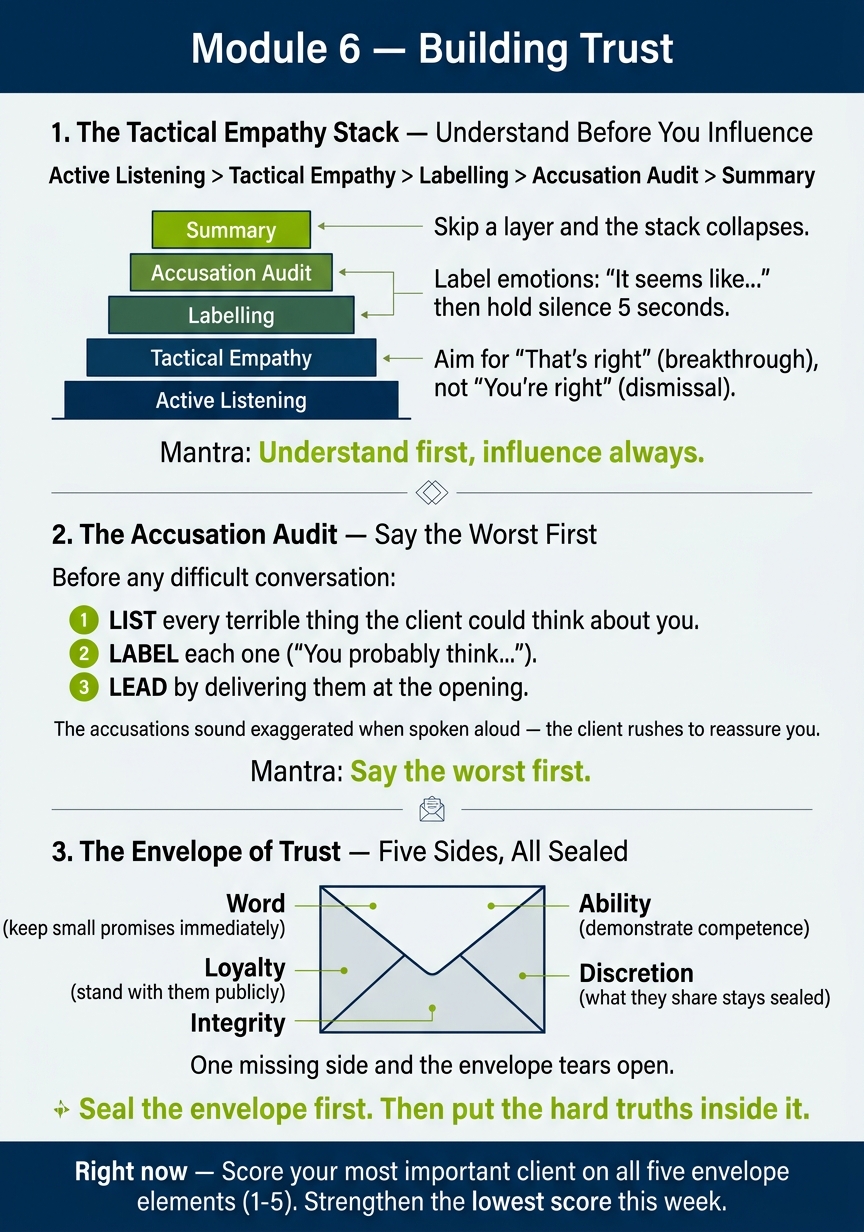
Presenting with Impact
Structure your ideas, command the room, and make your recommendations land with conviction.
Managing Objections
Turn resistance into dialogue, handle pushback without defensiveness, and keep momentum when clients say no.
Difficult Conversations
Navigate tension, deliver hard truths, and de-escalate conflict without damaging the relationship.
Coaching Your Client
Shift from telling to asking, develop your client’s own thinking, and build lasting capability.
Reaching the CEO
Build a direct relationship with the decision-maker when you’re positioned further down the organisation.
The Advisor They Won’t Replace
Become the trusted authority your clients defer to — the one they stop shopping for and start building around.